In custom battery pack design, potting and encapsulation are essential processes used to protect cells and internal electronic components from moisture, vibration, electrical insulation. These processes are applied to battery enclosure sealing, cell fixation, and sensitive internal components protection.
Battery encapsulants account for small portion of total battery pack material cost, enhancing environmental resistance, heat dissipation, and reliability. Common battery encapsulants include epoxy resin, polyurethane, and silicone rubber, which protect battery packs from water and oxygen ingress, corrosion, and short circuits. This article explores potting and encapsulant types, processes and applications.
Why Potting or Encapsulation Matters in Lithium Battery Packs
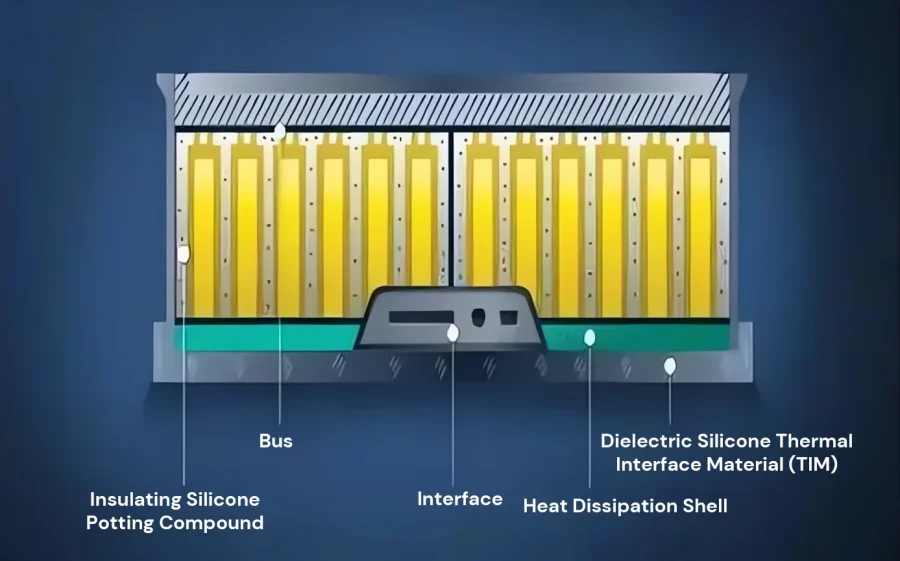
Lithium battery packs are not only energy storage systems—they are structural and thermal systems operating under real-world stress.
In many applications, failure does not originate from the cells themselves, but from environmental and mechanical factors such as:
- Vibration and mechanical shock, which can cause solder joint fatigue, wire detachment, or internal connection cracks.
- Moisture and contaminants, leading to corrosion, insulation breakdown, or leakage current.
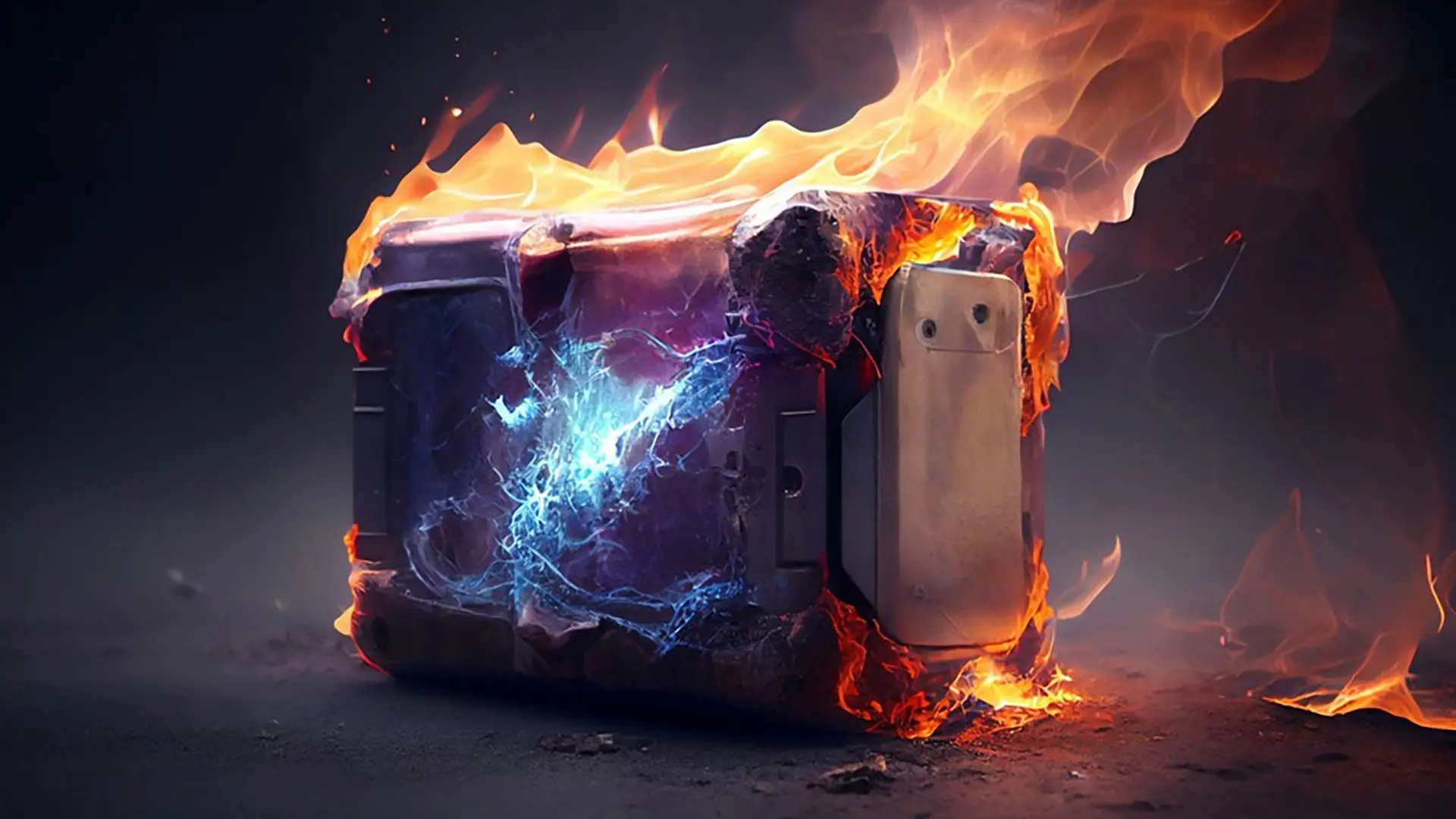
- Heat accumulation, especially in compact or high-power devices, which may accelerate cell aging or even trigger thermal runaway.
For low-stress indoor applications, a basic enclosure may provide sufficient protection. However, in high-vibration, outdoor, high-humidity, or high-power environments, a “bare pack + housing” structure is often not enough to ensure long-term reliability and safety.
Potting and encapsulation are not simply protective measures—they are engineering strategies to enhance structural stability, electrical insulation, and thermal management.
Whether potting is necessary depends heavily on your application environment, safety requirements, and overall pack architecture. In many cases, potting decisions are made too late—after thermal or certification issues appear.
Battery Potting vs. Battery Encapsulation: What’s the Difference?
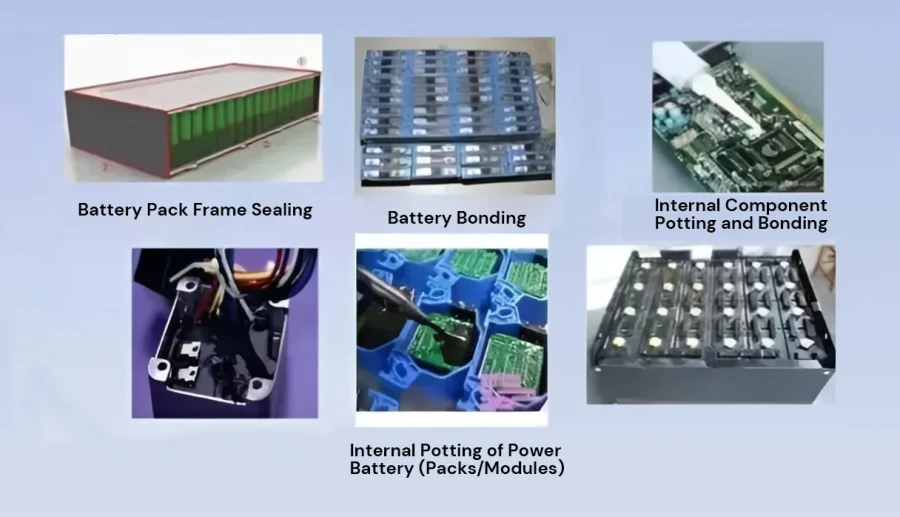
Although both methods use protective compounds to improve reliability, potting and encapsulation serve different engineering priorities.
The real difference is not the material itself—but how much of the battery system is sealed, and what problem you are trying to solve.
Key Decision Differences
1. Coverage Scope
- Potting: Partially or fully fills internal cavities, embedding cells or electronics inside the compound.
- Encapsulation: Forms a protective outer layer or shell around the assembly without fully embedding internal structures.
2. Serviceability
- Potting: Typically permanent and difficult to repair once cured.
- Encapsulation: Allows easier inspection, disassembly, or rework in some designs.
3. Thermal Behavior
- Potting: Can improve thermal conduction if thermally conductive materials are used—but may also trap heat if poorly designed.
- Encapsulation: Often favors better surface heat dissipation since internal components are not fully buried.
4. Cost Impact
- Potting: Higher material usage and longer curing cycles.
- Encapsulation: Usually lower material consumption and simpler processing.
5. Typical Applications
- Potting: High vibration, waterproof, explosion-proof, or tamper-resistant systems.
- Encapsulation: Applications requiring environmental sealing while maintaining maintainability or heat dissipation.
In short, potting prioritizes structural reinforcement and internal protection, while encapsulation emphasizes external sealing and balanced performance.
Battery Potting
Battery potting is a process in which liquid compounds are dispensed into designated areas
—or across the entire cavity—of a battery module or pack. After curing, the material forms a solid protective structure around cells, wiring, or electronic components.
Engineering Purpose
- Enhance vibration resistance and shock absorption
- Improve waterproofing and insulation
- Prevent component movement or wire fatigue
- Increase flame retardancy and structural stability
Where Engineers Hesitate
Potting strengthens protection—but it also changes the pack architecture. Engineers typically weigh:
- Will heat become trapped?
- Is future repair required?
- Does potting increase overall weight?
- How will it affect certification or testing?
Common Misconception
“More potting equals more safety.”Not necessarily. Excessive or poorly selected potting materials can:
- Block heat paths
- Increase internal thermal stress
- Complicate failure analysis
- Raise production costs without proportional safety gain
Effective potting is not about filling everything—it is about strategic placement and material matching.
Battery Encapsulation
Battery encapsulation forms a protective external layer or shell around the battery assembly rather than fully embedding internal components.
It typically uses materials with controlled adhesion or mold-release properties, allowing the protective layer to shield the system while maintaining some structural independence inside.
Engineering Purpose
- Provide environmental sealing against moisture and chemicals
- Improve high-temperature resistance
- Protect against dust and corrosion
- Maintain better thermal dissipation pathways
Where Engineers Hesitate
- Is sealing sufficient for high-vibration environments?
- Does the encapsulation material bond properly to the housing?
- Will environmental stress cause delamination over time?
Common Misconception
Encapsulation is often perceived as “lighter protection” than potting. In reality, when properly designed, it can provide excellent environmental resistance while preserving heat dissipation and serviceability.
Encapsulation is not a weaker alternative—it is a different protection strategy aligned with different system priorities.
Material Selection Depends on What You’re Protecting Against
In custom battery assembly and manufacturing, selecting proper battery encapsulants in potting and encapsulation is vital for manufacturers to ensure that battery remains waterproof, dustproof, shockproof, and reliable over the long term in extreme temperatures. Silicone rubber, epoxy resin and polyurethane are common battery potting compounds.
CM Batteries engineering team utilizes innovative potting materials, including battery encapsulation foam, thermoplastic polyamides and phase change materials(PCM) for lightweight, ultra-fast discharge and special-shaped structure battery pack.
Silicone Rubber
They cure into soft materials, available in both solid rubber and gel forms, reducing mechanical stress. Silicone rubber potting component is common material in high discharge rate battery pack. Its excellent elasticity allows it to perfectly cope with battery expansion and contraction during charging and discharging.
Advantages:
- Extreme thermal stability. Silicone rubber maintains physical properties at -50℃-200℃, preventing thermal runaway.
- Low stress protection. The texture is soft can absorb severe vibrations during protect extremely thin battery poles after curing.
- Ease of repair. Silicone materials allow for rework and component replacement after potting.
Limitations:
- Silicone rubber potting material offers low bond strength, requiring physical fastening structures and primers.
Epoxy Resin
The epoxy resin features with high structural rigidity, strong adhesion and electrical insulation, ideal for battery modules that require extremely high structural rigidity。
Advantages:
- Strong structural support. Epoxy resin provides high rigidity secures individual battery cells, serving as part of battery pack’s structural components.
- Excellent Barrier Properties. Epoxy resin exhibits strong resistance to electrolytes, acids, alkalis, and chemical solvents.
- Low Cost. Epoxy resin is cost-effectiveness in large-scale industrial production.
Limitation:
- Highly brittle. Epoxy resin has limited resistance to thermal cycling and is prone to cracking. Because it cannot be removed, the encapsulated battery pack cannot be repaired.
Polyurethane
Polyurethane offers balance between battery performance and cost, suitable for low to medium power battery packs.
Advantages:
- Excellent Adhesion. Polyurethane shines in superior adhesion to battery casings, such as plastic or aluminum, providing good sealing.
- Low-Temperature Toughness. Polyurethane potting remains elastic in cold climates, unlike epoxy resin which is brittle.
- Cost-effective high resistance materials. Polyurethane potting compound offers high resistance to degradation to temperatures over 200℃.
Disadvantages:
- Heat resistance bottleneck. Polyurethane becomes soften and degrade in high-current battery discharge. Furthermore, the potting process is sensitive to humidity. Improper handling can lead to air bubbles.
Battery Encapsulation Foam
Encapsulation foam is foamed polyurethane or foamed silicone, which expands to fill the gap between cells. It is used in battery systems that demands weight and impact resistance but have poor sealing performance.
Advantages:
- Lightweight and space optimization. Battery encapsulation has low-density foam to reduce battery pack weight and increase energy density. It offers strong plasticity and adapts to battery module complex structure, ideal for medical portable devices.
- Advanced thermal insulation. Internal porous structure of packaging foam, form thermal insulation barrier to block heat transfer. The thermal conductivity of polyurethane foam is 0.02-0.03W/(m·K) and silicone foam is 0.03-0.05W/(m·K)
Limitation:
- Long-term compression challenges. Battery encapsulation experience elastic attenuation and reduced rebound under long-term compression, resulting in weakened buffering. Some foam materials are hard to restore to original shape.
- Cost and process constraints. Ceramic foam materials, flame-retardant polyurethane foam have higher costs and strict production requirements, which increases battery manufacturing cost and complexity.
Thermoplastic Polyamides
Thermoplastic polyamides are widely used in low-pressure molding, enabling fast battery encapsulation, PCBs, and BMS to improve production efficiency. They are well suited for compact custom battery designs, but have limited high-temperature resistance and reparability.
Advantages:
- Vibration resistance. Thermoplastic polyamides boasts tensile strength, impact resistance, and protect the BMS, PCB and wiring harness connection for enhancing battery system structural reliability
- Thermoplastic polyamides is ideal for low pressure injection molding(LPM) process with short curing time, which is conducive to automated production. It realizes battery integrated packaging of complex geometric structures.
Limitation:
- Strict environment control. Thermoplastic polyamides absorbs moisture in the air, which causes dimensional changes. Therefore, the moisture content needs to be strictly controlled during material storage, pretreatment.
- Limited long-term heat resistance. Thermoplastic polyamides meet most packaging needs, is not suitable as potting material close to heat source. It is more suitable for local packaging in BMS and connection areas.
Phase Change Materials(PCM)
Phase change materials (PCM) offers passive thermal management by absorbing battery heat. However, they are costly and work with high thermal-conductivity materials to control temperature rise and enhance safety in high-rate discharge.
Advantages:
- Efficient passive thermal management. PCM absorbs lots of heat during phase change process, buffering heat generation in high-rate conditions without increasing energy consumption, and inhibiting temperature rise. It shines in passive temperature control advantage in high-power battery pack.
- Suppress temperature rise. PCM reduces temperature rise rate to buy time for BMS monitoring. Therefore, PCM is used in custom battery pack with high safety demands.
Limitation:
- Low thermal conductivity. Most PCMs transfer heat slowly, which limits cooling efficiency when used alone. They need to be combined with high-thermal-conductivity materials while increases battery complexity.
- High encapsulation and reliability requirements. Solid–liquid phase transitions cause leakage and volume changes, requiring robust sealing.
Note:Material selection is not a catalog decision—it must align with cell chemistry, heat dissipation strategy, and certification requirements.
When Is Battery Potting Necessary for Lithium Battery Packs?
Battery potting and encapsulation are effective means to improve safety and consistency when lithium battery packs face high safety risks, harsh environments, high power heat generation, or long-term mechanical stress.
High-Safety Requirements Equipment
- AMR, AGV and service robots experiences frequent start-stop cycles, and high-rate discharge. Battery potting secures the cells and BMS, reducing loosening and internal short circuits risks.
- Marine Buoys, electric boats and ROV. Encapsulation components offer waterproofing, salt spray protection, and corrosion resistance, preventing moisture intrusion.
- Aerospace and Military Equipment. Meeting high reliability and extreme temperature redundancy.
High-power and Heat-constrained Devices
- High-rate and high-power-density battery packs. Thermally conductive potting compound improves heat diffusion and reduces localized overheat.
- Compact battery design. Battery potting fills cells gaps forms stable heat conduction path.
Insulation and Electrical Safety
- High-voltage battery system. Battery potting offers electrical insulation to reduce short circuits and breakdown risks.
- Equipment with high EMC demands. Battery potting reduces internal electromagnetic interference and improve system stability.
Conclusion
Battery potting and encapsulation are not mandatory for every lithium battery pack, but they are critical in devices with high safety and reliability. Battery potting stabilizes internal structure and reduces thermal and mechanical stress in devices such as robots, ships, industrial systems, and medical equipment.
Selecting the right potting material and process allows manufacturers to balance protection, thermal performance, weight, and cost.
For OEM and system integrators, the safest approach is working with a battery pack manufacturer that evaluates potting, materials, thermal paths, and compliance as a single system—not isolated choices.