Battery-powered LED lighting is increasingly used in portable, off-grid, and backup applications where direct connection to 220V mains power is impractical.
Batteries used in LED lighting systems have a hard time working well and safely because they are enclosed and exposed to high temperatures and humidity for long periods of time. Choosing the right LED light battery is very important for making sure the system works well, uses little energy, and stays safe over time.
As you read this guide, you’ll learn how to choose the right battery chemistry, make sure the voltage works with your LED lights, estimate the battery’s capacity and life, make sure it can handle different environments, and make sure it’s safe.
Do LED Lights Always Have to Be Plugged in?
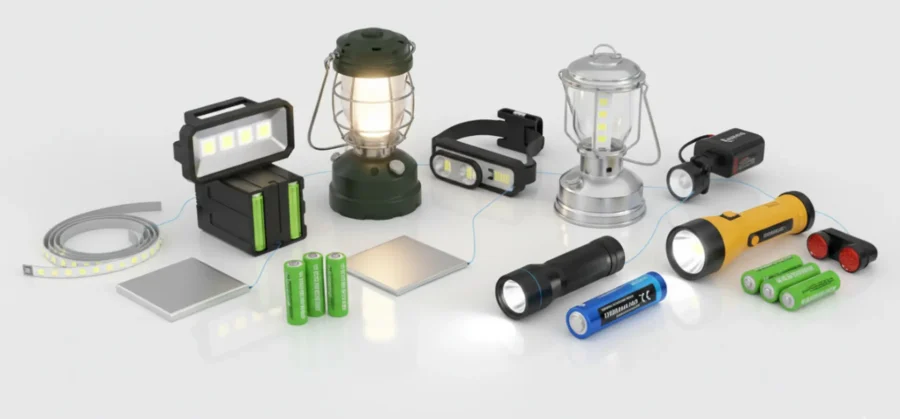
No. LED lights do not always have to be plugged into mains power. LED lights require power source, which can be supplied through wall adapters, batteries, solar panels. Many LED systems are designed to operate on DC power supplied by battery packs, such as portable, emergency, remote installations. Rechargeable lithium battery packs are widely used in LED lighting due to their high energy density, stable voltage output, and flexible customization options.

Why LEDs Work Well With Battery Power?
- Electrical Compatibility. LED lights are low-voltage direct current (DC) devices, and batteries naturally supply DC power. Powering LED lights without complex AC-to-DC conversion reduces component count and complexity.
- High energy efficiency and low power consumption. LED lights require less electrical power than incandescent and fluorescent lamps under the same brightness conditions, making them suited for battery-powered operation.
- Low heat generation. LED lights generate less heat during operation, which reduces system thermal stress on the battery, improving system stability and lifespan.
- Portability and flexibility. Battery-powered LED lights enable continuous operation in mobile, off-grid, or temporary lighting scenarios where fixed power connections are unavailable or impractical.
What Types of Batteries Are Used in LED Lighting?
Batteries that can be charged and batteries that can’t be charged are both used in LED lighting systems, based on the runtime, size, maintenance needs, and cost.
Rechargeable Battery for LED Lights
Rechargeable lithium batteries offer high energy density, mature customization capability, and extended cycle life, making them the preferred choice for most modern LED lighting systems.
Lithium Battery for Led Light
- Lithium Iron Phosphate Batteries: LiFePO₄ batteries boast high safety, superior thermal stability, long cycle life over 2,000 cycles. Additionally, they work reliably across wide temperature range, ideal for solar-powered street lights, large outdoor LED lighting.
- Ternary lithium-ion batteries with NCM or NCA chemistry offer a steady voltage range and higher energy density. They are suitable for portable and handheld LED lights requiring high brightness and fast charging. However, high-nickel variants present increased thermal risk and require effective battery management systems (BMS) to ensure safe operation under high load or fast charging conditions.
Lithium Polymer Battery
LiPo batteries are a form factor and packaging type of lithium-ion batteries, offering flexible shapes and compact designs. Its structure allows them to be manufactured in various shapes and sizes, making them ideal for LED lighting designs with form-factor constraints. They offer high energy density and are integrated with protection circuits to prevent overcharge, over-discharge, ideal for wearable LED lights, portable lighting devices.
Nickel-Metal Hydride (Ni-MH) Battery
Ni-MH batteries are environmentally friendly and free from toxic heavy metals such as cadmium. They offer 500–1,000 charge cycles, good safety performance, and lower cost compared to lithium-ion batteries. cost-sensitive LED products where compact size and high energy density are not critical.
Non-Rechargeable Battery for LED Lights
AA/AAA Alkaline Batteries: Alkaline batteries provide a nominal voltage of 1.5V and stable output under low to moderate loads. They require no charging, offer long shelf life, and are suitable for low-power LED applications such as decorative lights and motion-sensing lamps.
How to Choose the Right Battery for LED Lights?
LEDs are current-driven devices, while batteries are voltage sources. Directly connecting LEDs to batteries without current regulation can cause rapid current rise and premature LED failure.
Selecting the right battery for battery-powered LED lights is a system-level decision involving voltage matching, usable energy, discharge capability, energy density, and built-in safety protection.
Voltage Compatibility
When powering LED lights with batteries, voltage compatibility is a vital design concern for safe operation. Battery with insufficient voltage leads to reduced brightness and unstable operation, while excessive voltage accelerates aging and damage the LED lights.
Common LED system voltages include 3.7V, 12V, 24V, and 48V. Since a single lithium cell cannot meet higher voltage requirements, multiple cells are connected in series to form a battery pack.
- 12V LED systems: Powered by a 12V battery for LED lights, suitable for compact setups with short cable runs.
- 24V LED systems: Preferred for longer cable distances due to lower current and reduced voltage drop.
Battery Capacity, Energy Density, and Runtime
Runtime depends on both battery energy capacity and LED power consumption. Battery capacity is measured in ampere-hours (Ah) or watt-hours (Wh):
Battery Energy (Wh) = Voltage (V) × Capacity (Ah)
Runtime (hours) = Battery Energy (Wh) ÷ LED Power (W)
For example, a 12V 10Ah battery pack provides 120Wh of usable energy (12V×10Ah=120Wh). A 12W LED light can theoretically operate for 10 hours (120Wh÷12 W=10 hours).
Higher energy density batteries allow longer runtime within limited size or weight. NMC lithium batteries offer 180–230Wh/kg and are ideal for compact, portable LED lighting, while LiFePO₄ batteries prioritize longevity and stability.
Discharge Current and Load Stability
Reliable LED lighting systems require batteries capable of sustaining the required discharge current without excessive voltage drop or thermal stress.
- Insufficient discharge capability leads to voltage sag and LED driver instability.
- High discharge current increases internal heat, accelerating capacity fade.
- Battery management systems (BMS) limit discharge current to protect cells under extreme load conditions.
Selecting Lithium Battery for LED Light Applications
Here we summarize common types LED lights, battery requirements and recommend rechargeable battery for led light:
| Operating Environment | Battery Requirements | Lithium Battery Type |
| Portable Lighting (camping, emergency LED lights) | Lightweight; high energy density; compact or custom form factor | Lithium polymer battery pack |
| Indoor Fixed LED Lighting (smart home, ambient LED lights) | Stable discharge current; long cycle life; BMS protection | 18650/21700 lithium-ion battery pack |
| Outdoor LED Lighting (garden, pathway LED lights) | Wide temperature range; high thermal stability; long service life | LiFePO4 battery pack |
| Safety-Sensitive Applications (children’s rooms LED lights) | Low-voltage operation; safety protection circuits | Low-voltage protected custom battery pack |
Safety and Compliance for LED Light Batteries

Proper thermal, environmental, and regulatory protections are vital to ensure safe, reliable, compliant operation of battery-powered LED lighting systems.
Overcharge and Over-discharge Protection
Overcharging and over-discharging cause severe damage to lithium batteries and increase safety risks. Overcharge is one of the safety concerns for lithium-ion batteries according to IEC62133.
To migrate these issues:
- Integrates battery management system (BMS) in battery-powered LED lights to monitor cell voltage, charge and discharge current, and temperature to prevent unsafe operating conditions.
- Use battery packs and chargers that are designed for the required voltage range of LED lights. For instance, use 12 volt battery pack for 12V LED lights.
Thermal Management and Temperature Control
Heat accumulation in sealed LED housings accelerates battery aging and reduces cycle life.
Thermal protection strategies include:
- NTC temperature sensors monitored by the BMS
- Passive heat dissipation through enclosure design
- Thermal derating to reduce LED drive current at high temperatures
- Thermally conductive interface materials (TIMs) to improve heat transfer
Battery Enclosure and Ingress Protection
Ingress protection depends on enclosure structure, materials, and sealing design.
- Ingress Protection(IP rating), as defined by IEC60529, describes the ability of sealed enclosure to prevent the ingress of solid particles and water. For LED battery packs, ingress protection is determined by enclosure sealing design.
- Aluminum alloy enclosures outshines corrosion resistance and mechanical strength.
- Engineering plastics enclosures like polycarbonate(PC), ABS, and PC+ABS blends are suited in lightweight LED battery.
- Stainless steel enclosures are suitable for LED battery packs in corrosive marine environments.
International Certification Compliance
| Certification | Definition | Why It Matters to LED Battery Customers |
| IEC 62133 | International safety standard for lithium-ion cells and battery packs | Core safety requirement for LED battery packs |
| UN38.3 | UN transportation safety testing for lithium batteries | Mandatory global shipping for legally transported by air or sea |
| CE | EU conformity marking | Battery compliance affects CE approval and reduces redesign |
| UL | North American safety certification | US and Canadian LED projects requirement. |
| RoHS | EU restriction of hazardous substances | EU market access to ensures environmental compliance of battery materials |
For get more information about lithium-ion battery pack certifications, click out for article: guide to custom lithium-ion battery pack certification.
4 Tips for Extending Lithium Battery Life in LED Lights
- Use high-quality lithium battery cells from reputable battery manufacturer.
- Avoid prolonged exposure to high temperatures
- Reduce continuous high-load operation.
- Perform regular inspection and connector maintenance.
Powering Led Lights with Batteries
Battery-powered LED lighting is system-level engineering task rather than simple component selection.
Selecting proper battery types, electrical compatibility, safety protection, thermal management, and regulatory compliance reduce integration risk and redesign cycles.
Working with CM Batteries, a reliable lithium-ion battery manufacturer, enables the development of custom battery solutions covering cell selection, voltage matching, and BMS configuration. If you have any requests, please contact us.
FAQs About LED Light Battery
What Are the Best Batteries for LED Lights?
Rechargeable lithium batteries stand out for LED lighting requiring high brightness and long runtime. They boast high energy density, long cycle life, stable voltage output. Lithium polymer(LiPo) batteries feature with compact size while lithium iron phosphate (LiFePO₄) batteries offer enhanced safety.
Is 12V or 24V Better for LEDs?
It depends on system power, wiring distance, and efficiency requirements.
12V: Suitable for short distances, low power applications, or applications requiring high safety standards, such as home decoration. It has higher current but limited transmission distance.
24V: Ideal for long distances and high power applications, such as shopping mall lighting. It has a lower current and longer transmission distance, but requires more robust heat dissipation design.
How to Know If a LED Light Battery is Charging?
First, observe the indicator light. Some light strips have LED indicators that stay on or flash during charging. Second, measure battery voltage. Use multimeter to check the battery voltage. Then, Check the connections. Ensure that the power cord and connectors are not loose and match the charger specifications.
Can Christmas LED Lights be Powered by Lithium Batteries?
Absolutely! You can power Christmas LED lights using lithium battery packs when the battery voltage and current match the LED load. Rechargeable lithium-ion and lithium polymer batteries are used for battery-powered decorative and outdoor Christmas LED lights thanks to high energy density and excellent discharge performance.