Key Takeaways
- AA batteries are bigger and store more energy — best for high-drain devices like cameras, toys, and power tools.
- AAA batteries are smaller and lower-capacity — best for compact, low-drain devices like remotes and keyboards.
- Voltage is identical within the same chemistry (1.5V alkaline / 1.2V NiMH) — capacity and current output are what actually differ.
- The two sizes are never physically interchangeable, and for high-drain professional or industrial use, a custom lithium-ion battery pack outperforms both.
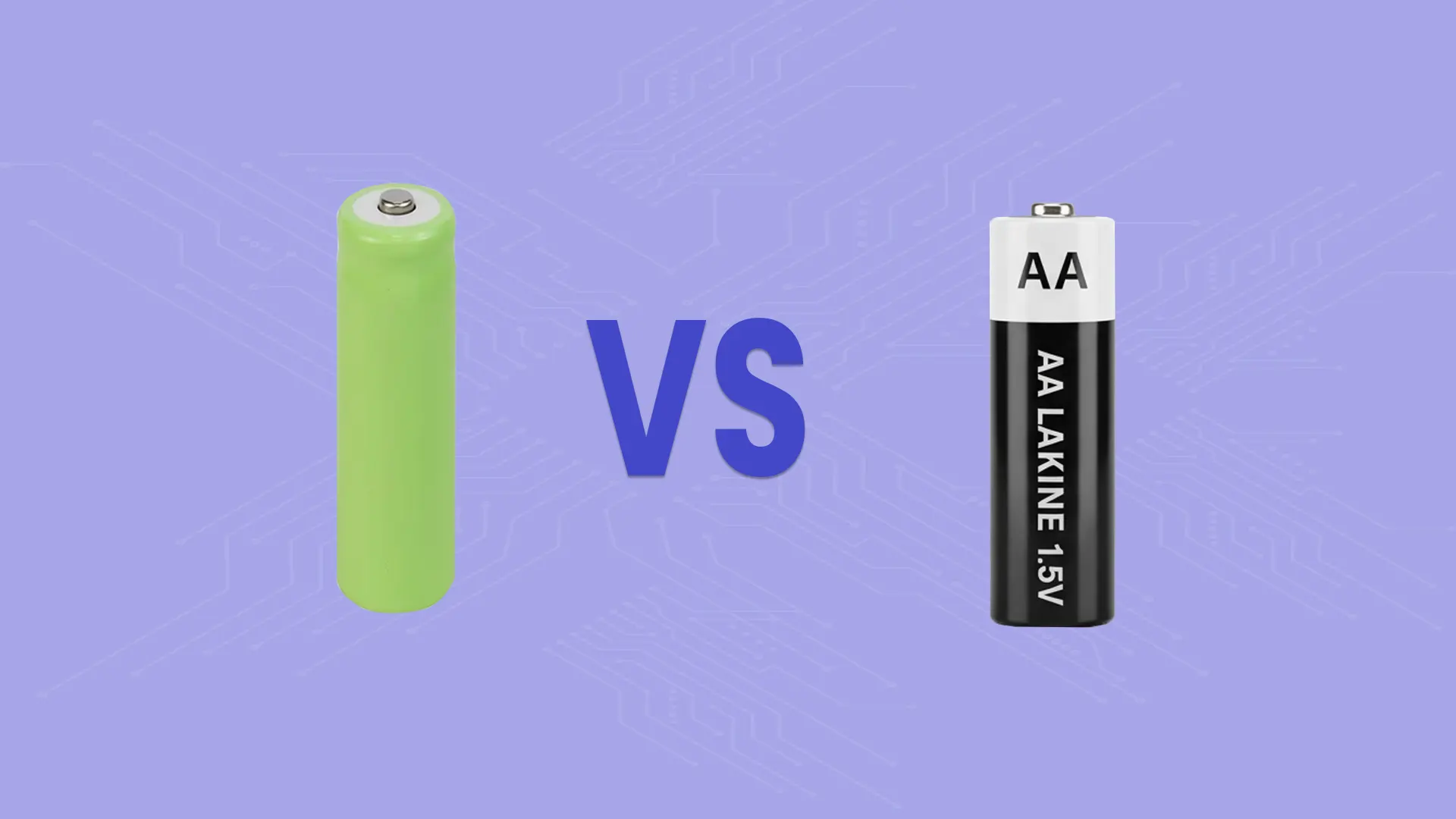
AA and AAA batteries are both standard 1.5V cylindrical cells, but they are not interchangeable. AA batteries measure 14.5 mm × 50.5 mm, hold roughly 1,800–3,000 mAh (alkaline), and are built for higher-drain devices like cameras, toys, and flashlights. AAA batteries measure 10.5 mm × 44.5 mm, hold roughly 800–1,200 mAh (alkaline), and are designed for smaller, lower-drain electronics like remote controls, thermometers, and wireless mice.
Both sizes are standardized under IEC 60086-1 (alkaline AA = LR6, AAA = LR03) and ANSI C18.1, so any brand’s AA or AAA will physically fit a device built for that size — but battery capacity, not size, determines how long a device runs. Choose AA when a device needs more power or longer runtime; choose AAA when the device is compact or draws little current.
What Are AA and AAA Batteries?
AA and AAA are internationally standardized cylindrical battery sizes, not battery chemistries. The letters describe physical dimensions only — an AA or AAA battery can be alkaline, lithium iron disulfide, nickel-metal hydride (NiMH), or nickel-cadmium (NiCd), and each chemistry changes the voltage curve, capacity, and shelf life while keeping the same outer shell size.
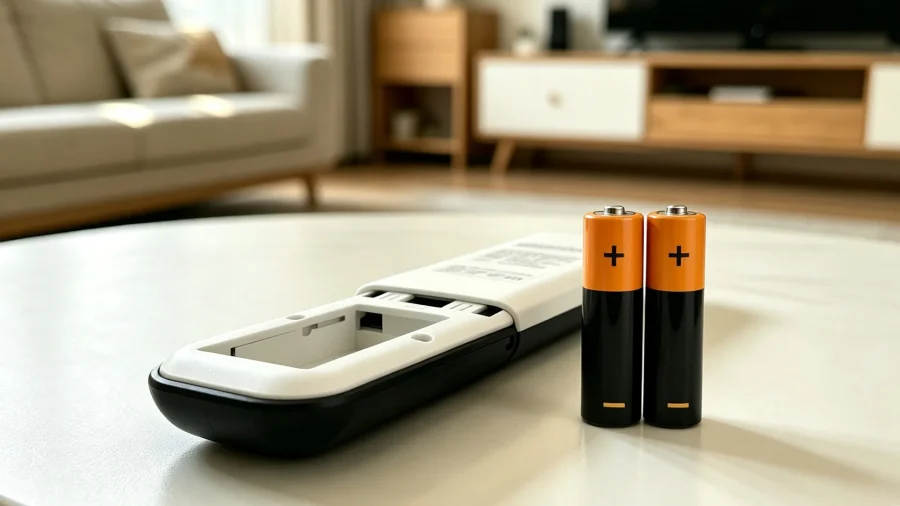
The AA cell was originally introduced by the Eveready Battery Company in 1907 for compact flashlights, and was formally standardized by ANSI in 1947 and by the International Electrotechnical Commission (IEC) in 1957. Today both AA and AAA sizes are governed by two parallel standards:
- IEC 60086-1 / 60086-2 — the international standard defining physical dimensions, terminal shape, and discharge performance. Under this system, the alkaline AA is coded LR6 and the alkaline AAA is coded LR03.
- ANSI C18.1 — the American standard covering the same dimensional and electrical requirements for U.S. markets.
Because both sizes are standardized, an AA battery from any certified manufacturer will physically fit any device designed to hold an AA cell — but as we’ll see below, size compatibility does not mean performance is identical.
AA vs AAA Size Comparison
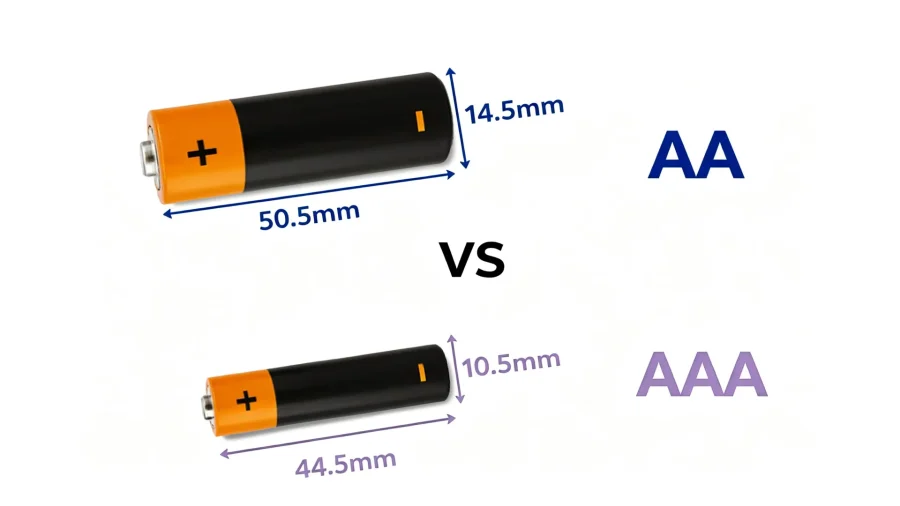
Size is the single biggest structural difference between the two formats, and it’s also the reason every other difference — capacity, weight, current output — exists in the first place. A larger canister simply holds more active chemical material.
| Specification | AA Battery | AAA Battery |
| IEC designation (alkaline) | LR6 | LR03 |
| Diameter | 14.5 mm (13.7–14.5 mm tolerance) | 10.5 mm |
| Length | 50.5 mm (49.5–50.5 mm tolerance) | 44.5 mm |
| Approx. weight (alkaline) | ~23 g | ~11–12 g |
| Nominal voltage | 1.5V (alkaline) / 1.2V (NiMH) | 1.5V (alkaline) / 1.2V (NiMH) |
| Alkaline capacity | ~1,800–3,000 mAh | ~800–1,200 mAh |
| Rechargeable (NiMH) capacity | ~1,700–2,750 mAh | ~600–1,000 mAh |
| Common use case | Cameras, toys, flashlights, game controllers | Remotes, thermometers, wireless mice, clocks |
Manufacturing tolerances mean a battery sold as “AA” may vary by a fraction of a millimeter between brands — this is normal and rarely affects device compatibility, since battery compartments are engineered with spring contacts that accommodate the full IEC tolerance range.
Voltage Difference Between AA and AAA
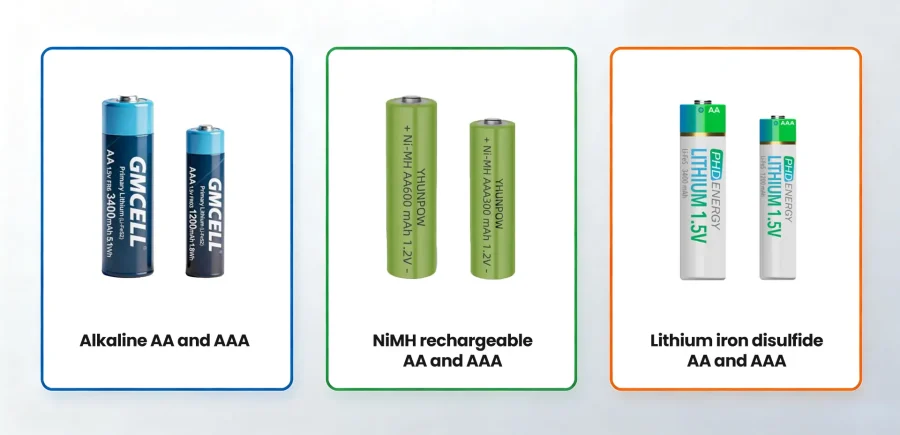
This is one of the most searched — and most misunderstood — parts of the comparison: AA and AAA batteries of the same chemistry produce the same voltage. Size affects capacity and current delivery, not voltage.
- Alkaline AA and AAA: both rated at a nominal 1.5V, with a fresh cell typically reading closer to 1.6V.
- NiMH rechargeable AA and AAA: both rated at 1.2V nominal.
- Lithium iron disulfide (Li-FeS₂) AA and AAA: both rated at 1.5V, with a flatter discharge curve than alkaline.
The practical distinction isn’t the voltage number — it’s how well each size sustains that voltage under load. Because the AA cell has more internal volume for chemical reactants and typically lower internal resistance, it holds its voltage more consistently in high-drain devices than an AAA cell of the same chemistry.
Capacity & Battery Life Comparison
Capacity — measured in milliampere-hours (mAh) — is where AA and AAA batteries diverge the most, and it’s the real driver of “which one lasts longer.”
| Chemistry | AA Capacity | AAA Capacity |
| Alkaline | 1,800–3,000 mAh | 800–1,200 mAh |
| NiMH (rechargeable) | 1,700–2,750 mAh | 600–1,000 mAh |
| Zinc-carbon | 400–900 mAh | Lower, similarly proportioned |
Because an AA cell physically holds roughly double the electrochemical material of an AAA cell, it typically delivers two to three times the capacity in the same chemistry. In practice, this means:
- In the same device, an AA battery will outlast an AAA battery of the same brand and chemistry.
- A device’s actual runtime also depends on current draw — a low-drain device (a wall clock) can stretch even a modest-capacity battery for years, while a high-drain device (a digital camera flash) can deplete a large-capacity AA cell in hours.
- Rechargeable NiMH batteries in both sizes lose some usable capacity compared to alkaline but make up for it with hundreds of recharge cycles, making them more cost-effective long-term for frequently used devices.
AA vs AAA Battery Performance (Amps & Power)
Beyond total capacity, AA batteries generally support a higher continuous discharge current (amperage) than AAA batteries of the same chemistry, because their larger electrode surface area and greater internal volume reduce internal resistance. This is why:
- AA batteries are the default choice for higher-current devices — DSLR camera flashes, motorized toys, and gaming controllers that need a steady current draw.
- AAA batteries are best suited to low-drain electronics — devices that sip power intermittently rather than pulling a continuous heavy load, such as remote controls or wall clocks.
Pushing an AAA battery into a high-drain role it wasn’t designed for typically results in a much shorter runtime and, in some chemistries, a steeper voltage drop under load — which is why manufacturers rate devices for a specific battery size rather than leaving it interchangeable.
Which Devices Use AA vs AAA?

Common AA devices:
- Digital cameras and camera flashes
- Flashlights and headlamps
- Motorized and electronic toys
- Game controllers
- Portable speakers
- Some smoke detectors
Common AAA devices:
- TV and AC remote controls
- Wireless computer mice and keyboards
- Digital thermometers
- Wall clocks
- Small flashlights and penlights
- Hearing aids and some medical devices (in specialized AAA-based formats)
Beyond AA/AAA: when consumer cell formats aren’t enough
AA and AAA cells are optimized for consumer electronics with modest, predictable current demands. For industrial, professional, and B2B applications — cordless power tools, robotics, IIoT edge devices, EV assembly equipment, and other high-drain or safety-critical systems — standard AA/AAA formats quickly hit their ceiling on both capacity and sustained current output.
This is where custom lithium-ion battery packs come in: engineered cell configurations (such as 5S1P or 5S2P arrangements using 18650-format cells), purpose-built BMS protection, and application-specific form factors deliver the higher voltage, higher discharge current, and thermal management that consumer AA/AAA batteries simply aren’t designed to provide.
If you’re evaluating power sources for a product that has outgrown off-the-shelf AA or AAA cells, a custom pack design is generally the next step up in both performance and reliability.
Which Battery Should You Choose?
| Use Case | Best Choice | Reasons |
| TV / AC remote control | AAA | Low, intermittent current draw |
| Digital camera | AA | Needs sustained higher current |
| Motorized toys | AA | Higher capacity, better current delivery |
| Wireless mouse | AAA | Compact device, low power draw |
| Flashlight (compact) | AAA | Space-constrained design |
| Flashlight (high-output) | AA | Higher capacity for longer runtime |
| Wall clock | AAA | Extremely low, steady drain |
| Smoke detector | AA or 9V | Long-term reliability, higher capacity preferred |
| Gaming controller | AA | Frequent, higher current use |
As a general rule: if a device is compact and used intermittently, it’s engineered for AAA. If a device is power-hungry or used continuously, it’s engineered for AA.
Always defer to the device manufacturer’s specification — swapping sizes isn’t physically possible without an adapter, and voltage mismatches between chemistries (e.g., using 1.5V lithium where 1.2V NiMH is specified) can affect sensitive electronics.
Can You Substitute One for the Other?
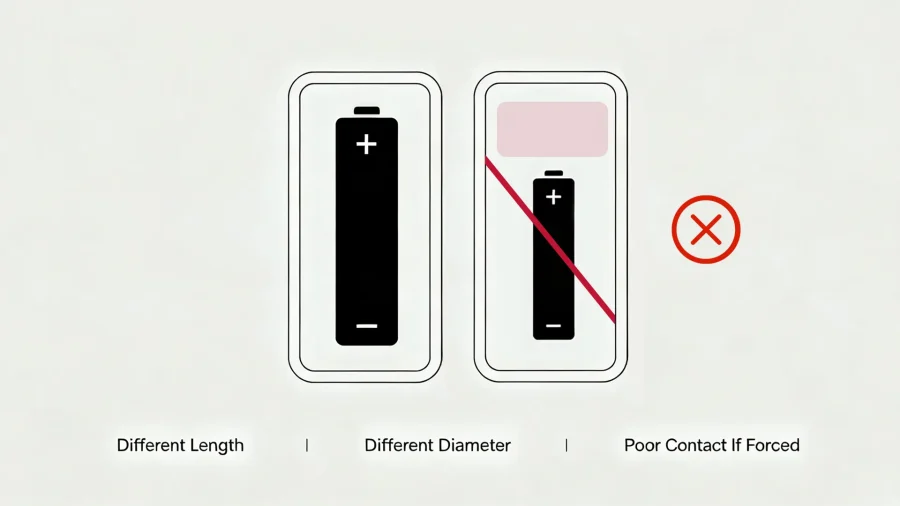
No — AA and AAA batteries are not physically interchangeable. An AAA cell is too small in diameter to make contact in a standard AA compartment, and an AA cell is too large to fit into an AAA compartment.
Devices requiring multiple AAA cells (for example, “2 AA batteries vs. 3 AAA”) cannot be substituted with a different battery count of the other size, either — battery compartments are wired for the specific voltage and physical footprint of the size they were designed for, not a mAh-equivalent swap. If a device’s battery compartment is AAA-sized, only AAA cells (in the correct chemistry and quantity specified by the manufacturer) will work safely.
Adapter sleeves that let an AAA battery fit into an AA-sized compartment do exist, but they don’t increase capacity or current output — they only solve a physical fit issue and are best treated as an emergency workaround rather than a long-term solution.
Cost Comparison: AA vs AAA
Price per unit is close between the two sizes despite the capacity gap, because manufacturing cost is driven more by chemistry than by the small difference in raw materials.
| Battery Type | Alkaline (per cell) | NiMH Rechargeable (per cell) |
| AA | ~$0.60–$1.00 | ~$1.00–$2.00 |
| AAA | ~$0.50–$0.80 | ~$1.00–$1.50 |
Because AA batteries deliver 2–3× the capacity for only a modest price premium, they generally offer better cost-per-mAh value. For devices used frequently, NiMH rechargeables in either size pay for themselves within roughly 15–20 charge cycles compared to continually buying alkaline replacements.
Safety, Leakage & Temperature Performance
Leakage risk
AAA batteries have a smaller internal volume and thinner casing than AA batteries, which makes them somewhat more prone to leakage if left in a device after full discharge or stored for long periods in high heat. AA batteries, with more material mass, tend to handle heat and mechanical stress slightly better over time.
Cold-weather performance
Both sizes lose capacity in cold conditions, but the effect is proportionally larger in smaller cells. Alkaline batteries can lose roughly 50% of usable capacity near 0°F (-18°C), while lithium iron disulfide (Li-FeS₂) versions of either size retain the vast majority of their capacity down to -40°F, making lithium primaries the better choice for outdoor, automotive, or cold-chain industrial equipment.
General safety practice
Store batteries in a cool, dry place;
remove batteries from devices that will sit unused for extended periods; never mix old and new batteries or different chemistries in the same device — doing so increases both leakage risk and the chance of uneven discharge.
How AA/AAA-Class Cells Are Tested for Reliability
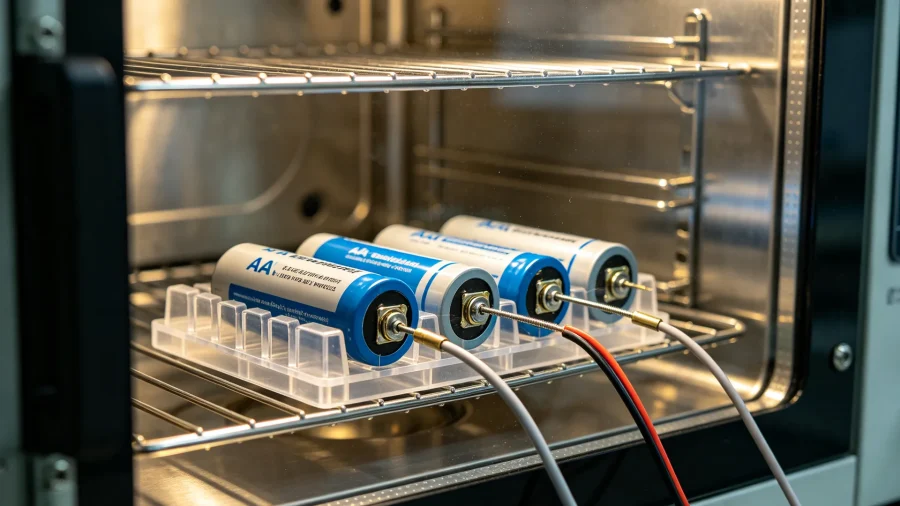
Battery reliability isn’t just a function of chemistry — it’s validated through standardized testing, and this is the same testing framework that applies to the custom cylindrical and pouch cells used in industrial battery packs:
| Test Type | What It Evaluates |
| Vibration testing | Mechanical durability under sustained movement — critical for automotive, robotics, and portable tool applications |
| Environmental testing | Performance across temperature and humidity extremes |
| Life-cycle testing | Long-term capacity retention across repeated charge/discharge cycles (for rechargeable chemistries) |
| Electrochemical impedance spectroscopy (EIS) | Identifies internal degradation patterns before they become visible in performance |
Consumer AA/AAA cells are tested to IEC 60086 performance thresholds, which are adequate for household electronics but considerably less rigorous than the cycle-life and safety validation applied to industrial lithium-ion packs — one more reason high-drain professional equipment is generally engineered around custom pack designs rather than off-the-shelf primary cells.
AA/AAA vs Custom Lithium-Ion Battery Packs
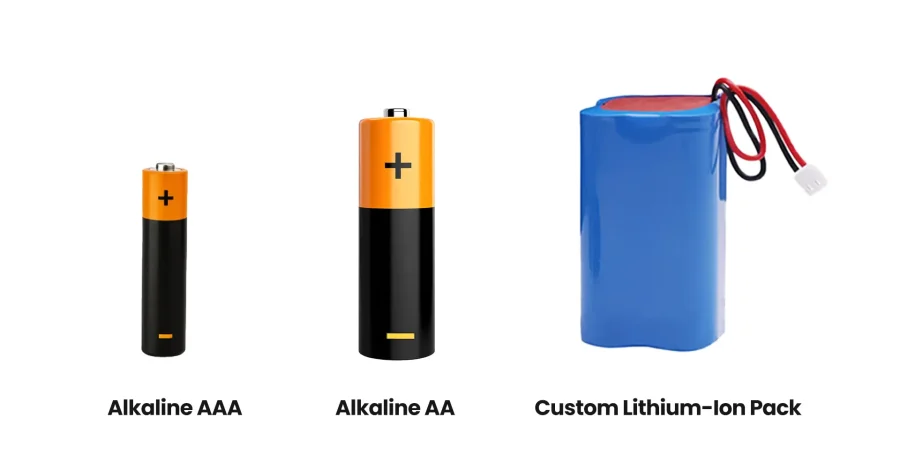
| Feature | Alkaline AA/AAA | Custom Lithium-Ion Pack |
| Energy density | ~100–150 Wh/kg | ~260–270 Wh/kg |
| Rechargeable | No (standard alkaline) | Yes |
| Cycle life | Single use | Up to several thousand cycles (e.g., LiFePO4 up to ~5,000) |
| Charge efficiency | N/A | ~99% |
| Weight | Fixed, non-optimizable | 50–60% lighter for equivalent energy vs. lead-acid |
| Customization | None — fixed size and capacity | Voltage, capacity, form factor, and BMS fully customizable |
For consumer gadgets, AA/AAA remains the simplest, most universally compatible option. But once a product needs sustained high current, a specific voltage, rapid charging, or a non-standard footprint — common in robotics, IIoT sensors, power tools, and EV-adjacent equipment — a custom lithium-ion pack is the more reliable long-term power solution.
FAQs
What is the difference between AA and AAA batteries?
AA batteries are larger (14.5 × 50.5 mm) with higher capacity (roughly 1,800–3,000 mAh alkaline), while AAA batteries are smaller (10.5 × 44.5 mm) with lower capacity (roughly 800–1,200 mAh alkaline). Both share the same 1.5V nominal voltage in alkaline form; the size difference affects runtime and current delivery, not voltage.
Are AA and AAA batteries interchangeable?
No. They have different diameters and lengths, and battery compartments are built to fit one size only. Adapter sleeves exist but don’t add capacity.
Which lasts longer, AA or AAA?
In the same device and chemistry, AA batteries generally last two to three times longer than AAA batteries because they hold significantly more capacity.
Do AA and AAA batteries have the same voltage?
Yes, within the same chemistry. Alkaline AA and AAA are both 1.5V; NiMH rechargeable AA and AAA are both 1.2V. The difference is in capacity and sustained current output, not voltage.
Why is an AA battery bigger than an AAA battery?
Both are standardized to different dimensions under IEC 60086-1 specifically to hold different amounts of electrochemical material — the larger AA canister stores more active material, giving it higher capacity.
Can I use rechargeable batteries in place of alkaline AA/AAA?
Yes, in most devices. Just note that NiMH rechargeables output 1.2V instead of 1.5V, which is compatible with the vast majority of consumer electronics but can slightly affect performance in a small number of voltage-sensitive devices.
What does “double A” or “triple A” battery mean?
These are the common spoken names for AA (“double A”) and AAA (“triple A”) batteries — the terms refer to the exact same standardized battery sizes.
Is a AAA battery the same as an A battery?
No. “A” is a separate, less common battery size, larger than AAA but smaller than AA. AA and AAA are the two standardized sizes covered in this guide.
Are AAA batteries more likely to leak than AA batteries?
Slightly, yes. Their thinner casing and smaller internal volume make them somewhat more prone to leakage after full discharge or extended storage in heat, though both sizes are safe when stored and used properly.
Do AA and AAA batteries perform differently in cold weather?
Yes. Alkaline batteries of either size can lose about half their usable capacity near 0°F (-18°C). Lithium iron disulfide (Li-FeS₂) versions of both sizes retain far more capacity in extreme cold, making them the better choice for outdoor or industrial cold environments.
Is AA or AAA cheaper to run over time?
AA batteries cost slightly more per unit but deliver 2–3× the capacity, generally making them the better value per mAh. Rechargeable NiMH batteries in either size become more cost-effective than alkaline after roughly 15–20 charge cycles.