
48V 30Ah Low-Temperature Sodium-Ion Battery Pack for Outdoor Industrial IoT
In May 2026, an outdoor industrial IoT equipment manufacturer approached CMB with a requirement that most battery suppliers couldn’t meet: A custom battery pack that can both discharge and recharge in sub-zero field conditions. It supports devices used in climates where temperatures often drop to -40°C.
Their current lead-acid and LiFePO₄ battery options lost most capacity in the cold. They also could not accept a charge below freezing. This left field units stranded all winter. They had no way to recover after a solar-charging outage.
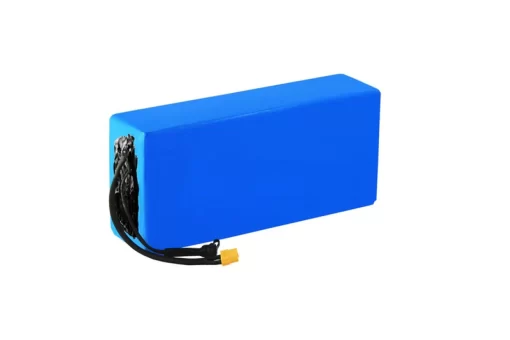
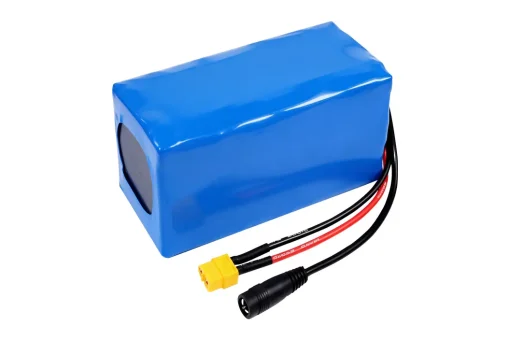
CMB’s solution was a custom 48V 30Ah sodium-ion pack (project code CMB16020256, 16S2P, 32× 3.0V 15Ah cells), GB 31241-2022 compliant and IP54 rated, validated by the numbers above.
Outdoor Industrial IoT Equipment Customer Overview
The customer is an industrial IoT equipment manufacturer building unattended field devices for deployment in extreme cold-climate regions. Their devices run on a solar-assisted charge cycle with no grid backup, so battery performance during the (short, still-cold) daylight charging window is as operationally critical as discharge performance overnight.
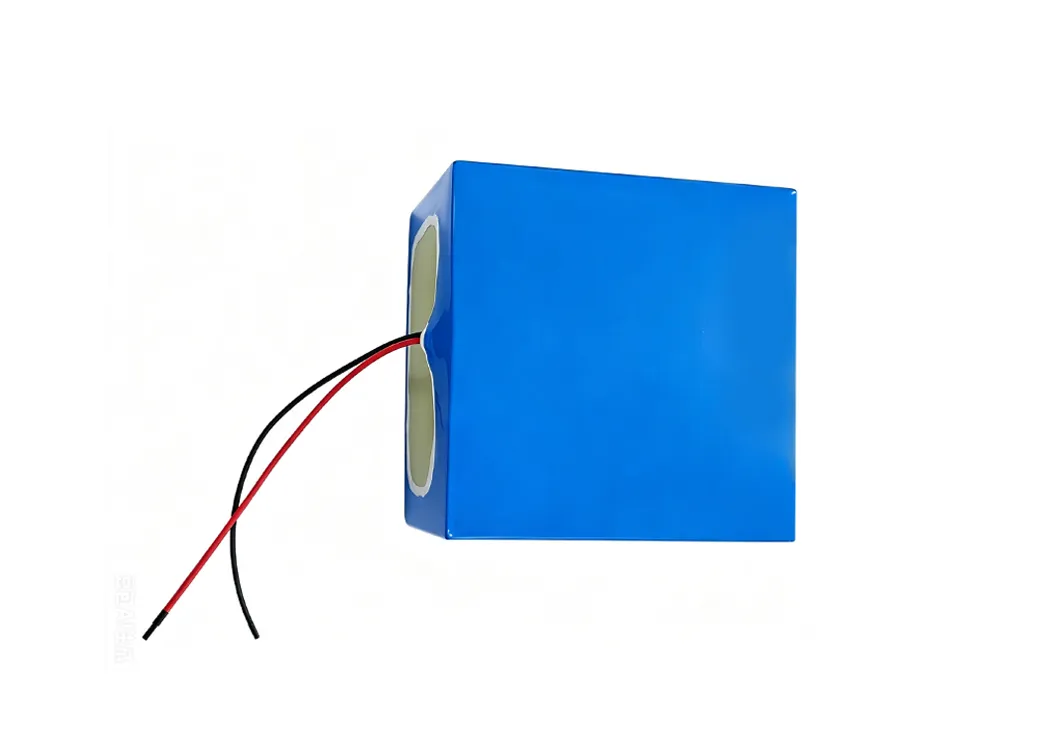
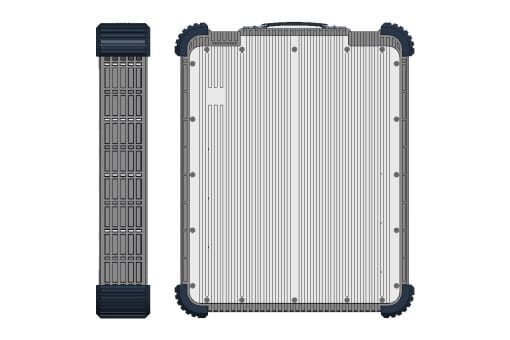
48V 30Ah 16S2P Sodium-Ion Battery Pack Design
Product Highlights
- Cell configuration: 16S2P (32x cylindrical 3.0V 15Ah sodium-ion cells)
- Ingress protection: IP54
- Nominal voltage / capacity: 48V / 30Ah @0.2C
- Charge temperature: -20°C to 60°C — charges where most LiFePO4 packs cannot
- Discharge temperature: -40°C to 60°C
- Capacity retention at -40°C: 85.5-85.8% measured, vs. >=80% guaranteed minimum
- Cycle life: ≥2,600 cycles at ≥70% capacity retention

Test Evidence of the 48V 30Ah Low-Temperature Sodium-Ion Battery Pack
Three independent test runs on the same 48V 30Ah sodium-ion battery pack, each logged second-by-second for current, voltage, temperature, and capacity across every step. Below is what each test was designed to prove, the exact protocol used, and the measured result.
Test 01 — Ambient Capacity Baseline
Test ID: CMB16020256 · Logged 2026-06-25
Protocol:
Rest, then CC-CV charge at 15A (0.5C) to 63.2V (cutoff ≤1.5A), rest 20 minutes, then CC discharge at 15A (0.5C) to a 22.4V cutoff. Ambient lab temperature logged at 33.6–34.6°C throughout.
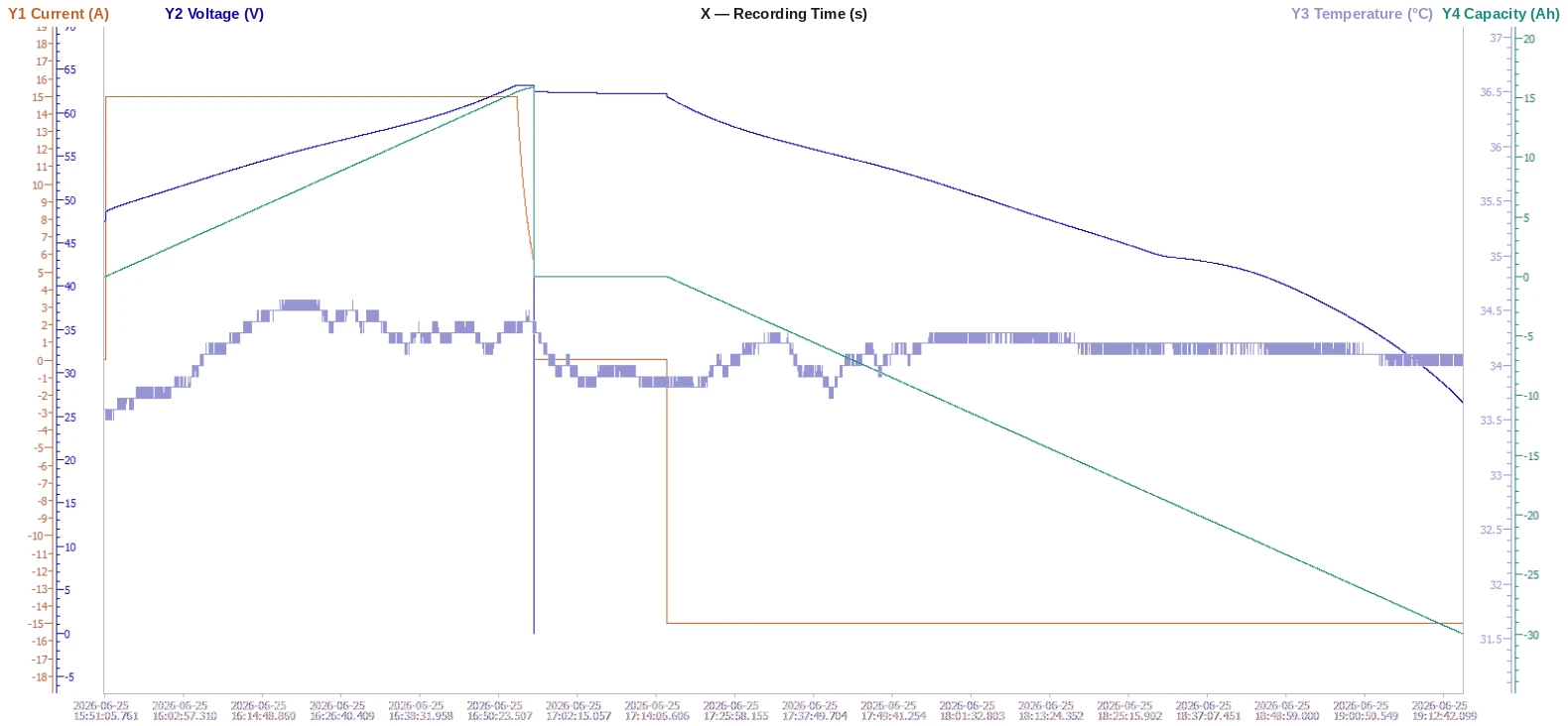
Voltage (navy, solid, left axis) · Capacity (teal, solid, near-right axis) · Temperature (lilac, dashed, far-right axis) — 3.4h total runtime.
Result:
discharged 29.989 Ah before hitting the 22.4V cutoff — the reference figure every retention percentage in this case study is measured against.
Test 02 — -20°C Charge / -40°C Discharge, 0.2C
Test ID: CMB16020256 · Logged 2026-06-26 to 2026-06-27
Protocol:
4-hour chamber soak at -20°C (logged -17.7°C), then CC-CV charge at 6A (0.2C) to 62.9V — completed the full CV taper down to a 0.631A cutoff, accepting 28.591 Ah. 5.5-hour soak down to -40°C (logged -38.2°C at discharge), then CC discharge at 6A (0.2C) to a 29.23V cutoff.
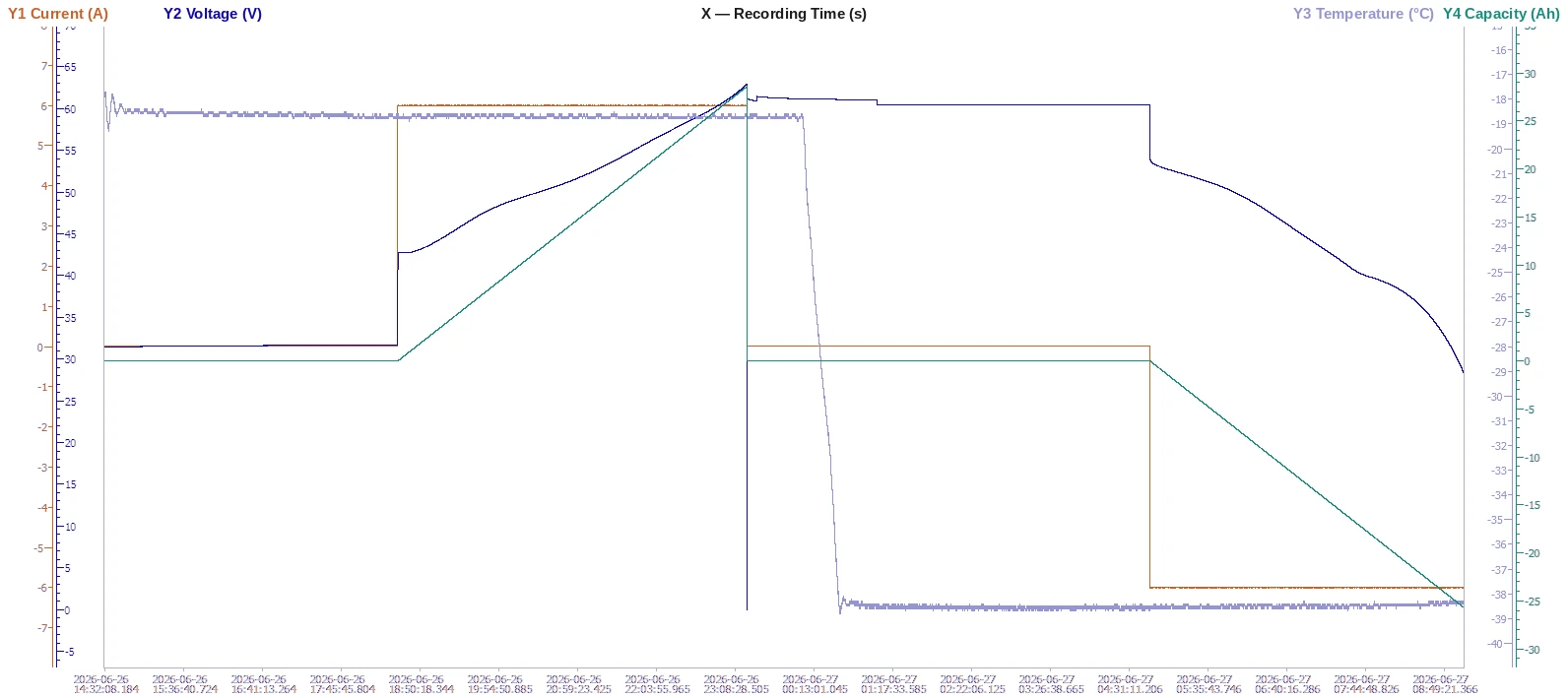
Voltage (navy, solid, left axis) · Capacity (teal, solid, near-right axis) · Temperature (lilac, dashed, far-right axis) — 18.5h total runtime.
Result:
discharged 25.727 Ah at -40°C — 85.8% of the 29.989 Ah ambient baseline — after completing a full charge at -20°C. This run stopped at a 29.23V cutoff, shallower than the pack’s officially rated 25.6V cutoff, so retention against the full rated discharge window is expected to be at or above this figure.
Test 03 — -20°C Charge / -40°C Discharge, 0.5C
Test ID: CMB16020256 · Logged 2026-06-30 to 2026-07-01
Protocol:
Same -20°C charge profile as Test 02 (logged -18.6°C), though this charge step ended at a 4.88A cutoff rather than completing the full CV taper, accepting 25.804 Ah. After a 5.5-hour soak (logged -38.4°C at discharge), CC discharge at 15A (0.5C) — three times the rate of Test 02 — to a 28.19V cutoff.
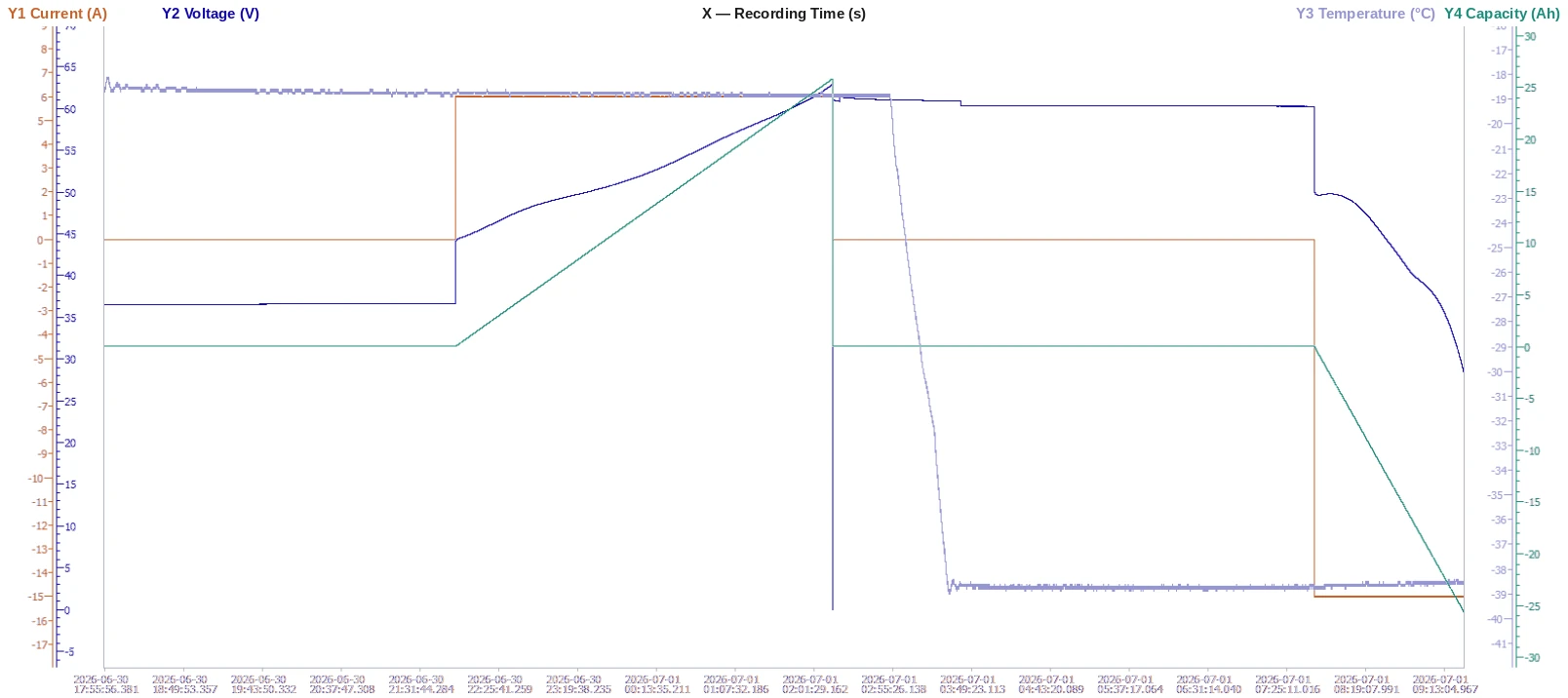
Voltage (navy, solid, left axis) · Capacity (teal, solid, near-right axis) · Temperature (lilac, dashed, far-right axis) — 15.5h total runtime.
Result:
discharged 25.631 Ah at -40°C under a 0.5C load — 85.5% of baseline, just 0.3 points below the lighter 0.2C run in Test 02. Retention holds under heavier real-world discharge current.
Full second-by-second logs (current, voltage, temperature, capacity vs. time) for all three runs are available on request.
| No. | Item | Specification | Note |
|---|---|---|---|
| 1 | Nominal Voltage | 48V | 3.0V/Cell |
| 2 | Nominal Capacity | 30Ah | @0.2C |
| 3 | Minimum Capacity | 28.8Ah | / |
| 4 | Initial Internal Impedance | ≤60mΩ | AC 1KHZ |
| 5 | Standard Charge Voltage | 63.2V | 3.95V/Cell |
| 6 | Standard Charge Current | 6A | @0.2C |
| 7 | Max Charge Current | 6A | -20°C~0°C |
| 15A | 0°C~+60°C | ||
| 8 | Standard Discharge Current | 6A | @0.2C |
| 9 | Max. Discharge Current | 15A | -40°C~+10°C +50°C~+60°C |
| 30A | +10°C~+50°C | ||
| 10 | Burst Discharge Current | 100±15A | ≤300ms |
| 11 | Discharge Cut-off Voltage | 25.6V | 1.6V/Cell |
| 12 | Cycle Life | ≥2600 cycles | Retention: ≥70% |
| 13 | Charge Temperature | -20°C~+60°C | Standard Charge |
| 14 | Discharge Temperature | -40°C~+60°C | Standard Discharge |
| 15 | Storage Temperature | -20°C~ +35°C | ≤3 Months |
| -10°C~ +25°C | ≤1 Year | ||
| 16 | Weight | About 14 | kg |
| 17 | Special Request | IP54 | / |

FAQs — 48V 30Ah Sodium-Ion Battery Pack for Outdoor Industrial IoT
Why does this pack charge at -20°C when most LiFePO₄ battery packs can't charge below 0°C?
Low-temperature charging in graphite-anode lithium cells risks metallic lithium plating, a safety and degradation failure mode — which is why most LiFePO₄ packs restrict charging below 0°C. Sodium-ion cells behave differently at the anode during cold charging, which is what allows this pack to be charge-rated down to -20°C, at a reduced max charge current of 6A in that band.
How does the measured -40°C retention compare to the product's official spec?
The product is specified to guarantee ≥80% capacity retention at -40°C discharge. Lab validation runs measured 85.5–85.8% — above the guaranteed minimum. These runs used a shallower discharge cutoff than the product’s officially rated 25.6V; final confirmed figures against the full rated cutoff are pending engineering review and may be revised upward.
Is sodium-ion safer than NCM/NCA lithium chemistries for outdoor deployment?
Sodium-ion cells use a different intercalation chemistry that is inherently less prone to the thermal runaway pathways associated with high-nickel NCM/NCA cathodes. This pack has passed a 130°C heat-box test and GB40165-2021 vibration testing without fire or explosion, and complies with GB 31241-2022.
What's the trade-off versus a lithium pack of the same capacity?
Sodium-ion cells currently have lower energy density than NCM lithium, so a 30Ah sodium pack is somewhat larger and heavier than an equivalent-capacity lithium pack. For deployments where cold-weather charge/discharge reliability matters more than minimizing weight, that trade-off favors sodium-ion.
Can we get the full product specification and raw test data for engineering review?
Yes. The full GB 31241-2022 compliant product specification, plus second-by-second logged test data (current, voltage, temperature, capacity vs. time) for all validation runs, is available on request.
Can the custom sodium-ion battery pack configuration be customized for our voltage or footprint requirements?
Yes. Cell count, capacity, connector, and enclosure can be adapted — this 48V 30Ah 16S2P configuration is a reference build, not a fixed SKU.
Tailored Customization
Our design team can create custom battery designs for just about any device or machine.
Timely Delivery
Our efficient production and distribution process gets your product delivered in a timely manner.
Quality Guarantee
We stand by our products and guarantee you’ll be happy with your purchase.