

Key Takeaways
- AA is a size standard, not a chemistry — alkaline, NiMH, lithium (Li-FeS₂), zinc-carbon, and rechargeable Li-ion (14500) all share the AA form factor, but perform very differently.
- No single chemistry is “best” — each one is the right answer for a different combination of drain rate, temperature, and usage frequency.
- NiMH rechargeables typically pay for themselves within 6–12 months for devices where batteries are replaced two or more times a year.
- For sustained high-drain or industrial use, a custom lithium-ion battery pack outperforms any off-the-shelf AA cell on capacity, cycle life, and discharge current.
An AA battery is a standardized cylindrical cell measuring 14.5 mm × 50.5 mm under IEC 60086-1 (alkaline designation: LR6) and ANSI C18.1. The size is fixed, but the chemistry inside varies widely, and each one suits a different job. Alkaline AA cells deliver 1.5V and roughly 1,800–3,000 mAh with up to 7 years of shelf life — the default for general household use. NiMH rechargeables deliver 1.2V, roughly 800–2,700 mAh, and 500–1,500 recharge cycles — the better economics for frequently used devices.
Lithium iron disulfide (Li-FeS₂) primaries deliver 1.5V with superior cold-weather and high-drain performance, at a higher per-unit cost. Zinc-carbon is the lowest-cost, lowest-performance option, suited only to very light loads.
Rechargeable Li-ion in the AA-sized 14500 format delivers 3.7V — more than double a standard AA’s voltage — and must never be used in a device designed for 1.5V. Choosing correctly means matching chemistry to your device’s drain rate, temperature exposure, and how often you’re willing to replace or recharge.
What Is an AA Battery?
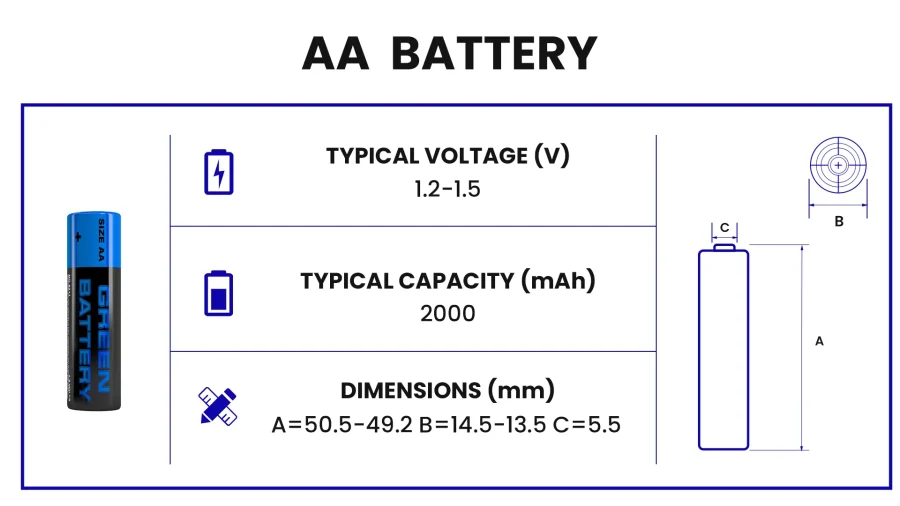
AA is an internationally standardized cylindrical battery size — not a chemistry. The designation covers dimensions and terminal shape only, which is why an AA battery can be built from several very different electrochemical systems while still fitting the same battery compartment.
Standard dimensions:
| Specification | Value |
| Diameter | 14.5 mm (13.7–14.5 mm tolerance) |
| Length | 50.5 mm (49.5–50.5 mm tolerance) |
| IEC designation (alkaline) | LR6 |
| Management Standards | IEC 60086-1 / IEC 60086-2, ANSI C18.1 |
The AA cell was introduced by the Eveready Battery Company in 1907, standardized by ANSI in 1947, and adopted into the IEC framework in 1957. It remains the most widely produced battery size in the world, used across consumer electronics, medical devices, and industrial tools.
The sections below walk through each chemistry that comes in this size, one at a time, so you can match the right one to your actual use case rather than defaulting to whatever’s on sale.
AA Battery Chemistries Compared
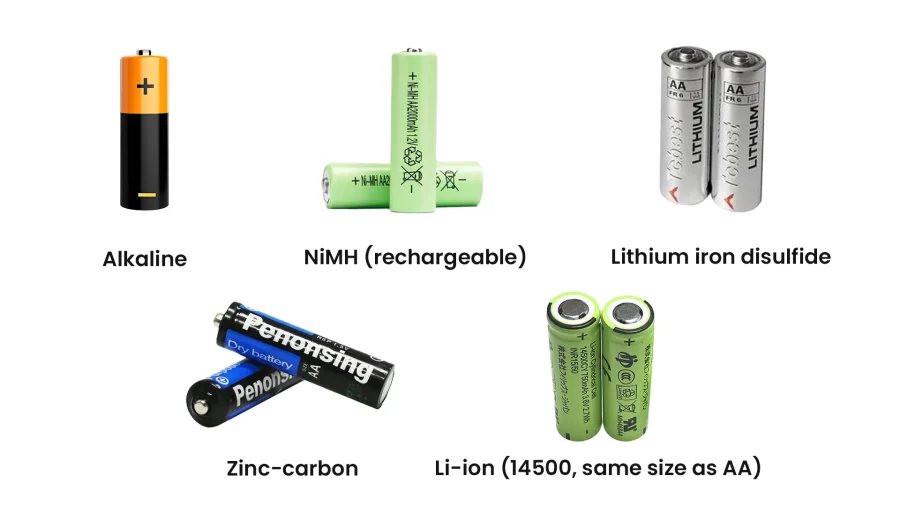
Before going deep on each one, here’s the map. Five chemistries account for essentially all AA batteries sold today:
| Chemistry | Nominal Voltage | Typical Capacity | Cycle Life | Shelf Life | Best For |
| Alkaline | 1.5V | 1,800–3,000 mAh | Single-use | Up to 7 years | Low-to-medium drain, infrequent use |
| NiMH (rechargeable) | 1.2V | 800–2,700 mAh | 500–1,500 cycles | 3–5 years (retained charge) | Frequent-use, medium-to-high drain devices |
| Lithium iron disulfide (Li-FeS₂) | 1.5V | ~2,700–3,000 mAh | Single-use | Up to 10–15 years | Cold weather, high-drain bursts |
| Zinc-carbon | 1.5V | 400–900 mAh | Single-use | 2–3 years | Very low-drain, budget use only |
| Li-ion (14500, same size as AA) | 3.7V | 700–1,000 mAh | 300–500 cycles | Varies | Only for devices specifically wired for 3.7V — never substitute for 1.5V devices |
Now let’s look at each one in detail.
Alkaline AA Batteries
Alkaline is the chemistry most people picture when they think “AA battery” — and for good reason. It’s the default choice sold in supermarkets worldwide, and it’s genuinely the right pick for a large share of household devices.
How it works:
Alkaline cells use a zinc anode, a manganese dioxide cathode, and an alkaline electrolyte (potassium hydroxide). This combination provides a steady 1.5V nominal output with a gradually declining voltage curve as the cell discharges — meaning a device will slowly lose power output over the battery’s life rather than dropping off sharply.
Performance profile:
| Parameter | Typical Value |
| Nominal voltage | 1.5V (fresh cell often reads ~1.6V) |
| Capacity | 1,800–3,000 mAh |
| Shelf life | Up to 7 years |
| Rechargeable | No |
| Cost | Lowest upfront cost of any 1.5V chemistry |
Strengths: widely available, long shelf life, no charging equipment needed, low upfront cost, works acceptably in the vast majority of low-to-medium-drain devices.
Limitations: voltage sags noticeably under continuous high-current draw, performance drops significantly in cold temperatures, and — because it’s single-use — the long-term cost and waste generated by frequent replacement can exceed rechargeable alternatives for high-use devices.
Best suited for: remote controls, wall clocks, flashlights used occasionally, toys used moderately, and any device where the battery sits unused for long stretches between uses.
NiMH Rechargeable AA Batteries
Nickel-metal hydride (NiMH) is the chemistry of choice when a device goes through batteries often enough that the cost and waste of disposables becomes noticeable.
How it works:
NiMH batteries use a metal hydride anode, a nickel hydroxide cathode, and an alkaline electrolyte. During discharge, hydrogen ions move between the electrodes in a reversible reaction — which is precisely what allows the cell to be recharged hundreds of times without significant degradation of the underlying chemistry.
| Reaction | Chemical Equation | What It Means |
| Negative electrode | H₂O + M + e⁻ ⇌ OH⁻ + MH | Hydrogen is absorbed/released by the metal hydride alloy |
| Positive electrode | Ni(OH)₂ + OH⁻ ⇌ NiO(OH) + H₂O + e⁻ | Nickel hydroxide converts to nickel oxyhydroxide |
| Overall discharge | NiO(OH) + MH → Ni(OH)₂ + M | Combined reaction that releases usable electrical energy |
| Total cell voltage | E⁰ ≈ 0.49V – (–0.83V) = 1.32V (theoretical) | Practical nominal voltage is rounded to 1.2V |
NiMH offers roughly 40% higher specific energy than older nickel-cadmium (NiCd) cells, and unlike NiCd, it doesn’t rely on toxic cadmium.
Performance profile:
| Capacity Tier | Typical Device |
| 800–1,800 mAh | Remote controls, wall clocks, low-drain electronics |
| 2,000–2,200 mAh | Toys, wireless keyboards, everyday electronics |
| 2,400–2,700 mAh | Digital cameras, game controllers, flashlights |
| Parameter | Typical Value |
| Nominal voltage | 1.2V |
| Charging voltage | 1.5V |
| Discharge cutoff voltage | 1.0V |
| Internal resistance | ≤ 60 mΩ |
| Cycle life | 500–1,500 charge cycles |
Charging best practices:
- Use a charger designed specifically for NiMH chemistry — a NiCd-only or generic charger doesn’t account for NiMH’s different charge termination profile.
- Choose a smart charger with automatic shutoff (delta-V detection) to prevent overcharging, heat damage, and premature capacity loss.
- Charge at moderate temperatures, ideally 50°F–86°F (10°C–30°C); extreme heat or cold during charging degrades long-term cycle life.
- Recharge before a cell fully depletes rather than routinely running it to zero — this extends overall cycle life more than deep-discharge cycling does.
Strengths: dramatically lower cost and waste over time for frequently used devices, stable voltage output throughout most of the discharge curve, no toxic cadmium.
Limitations: 1.2V nominal voltage is slightly lower than alkaline’s 1.5V (rarely an issue, but occasionally noticeable in voltage-sensitive devices), higher upfront cost per cell, requires a compatible charger, and self-discharges faster than alkaline or lithium if left unused for very long periods (though modern low-self-discharge NiMH cells largely close this gap).
Best suited for: digital cameras, wireless game controllers, toys, wireless mice and keyboards, and any device where batteries get swapped out two or more times a year.
Lithium (Li-FeS₂) AA Batteries
Lithium iron disulfide primary batteries are the premium, single-use option — built specifically for the two conditions where alkaline struggles most: extreme cold and heavy, continuous current draw.
How it works:
Li-FeS₂ cells use a lithium metal anode and an iron disulfide cathode with a non-aqueous electrolyte. This chemistry maintains a much flatter voltage curve throughout discharge than alkaline, and it isn’t nearly as sensitive to low temperatures, because the electrolyte doesn’t rely on water-based chemistry that thickens and slows down in the cold.
Performance profile:
| Parameter | Typical Value |
| Nominal voltage | 1.5V |
| Capacity | ~2,700–3,000 mAh |
| Shelf life | 10–15 years |
| Cold-weather performance | Retains the vast majority of capacity down to -40°F (-40°C) |
| Weight | Roughly 30–40% lighter than an alkaline AA of equivalent capacity |
Strengths: the best cold-weather performance of any AA chemistry, excellent for high-drain bursts (flash photography, motorized devices), very long shelf life, lighter weight than alkaline.
Limitations: noticeably higher cost per cell than alkaline, and — because it’s single-use — not a fit for high-frequency-replacement devices where NiMH would be more economical.
Best suited for: outdoor and cold-climate equipment, digital cameras used in winter conditions, high-drain devices used infrequently (so the long shelf life pays off), and emergency equipment stored for years before use.
Zinc-Carbon AA Batteries
Zinc-carbon is the oldest and most basic AA chemistry still on the market — and it exists purely as a budget option for the lightest possible loads.
How it works:
Zinc-carbon cells use a zinc anode and a manganese dioxide cathode with an acidic ammonium chloride or zinc chloride electrolyte (rather than alkaline’s basic electrolyte). This produces a much lower capacity and a voltage that sags more sharply under load than alkaline.
Performance profile:
| Parameter | Typical Value |
| Nominal voltage | 1.5V |
| Capacity | 400–900 mAh |
| Shelf life | 2–3 years |
| Cost | Lowest of any AA chemistry |
Strengths: lowest purchase price, adequate for extremely light, infrequent loads.
Limitations: capacity is roughly a quarter to a half of alkaline’s, shelf life is shorter, and performance in anything beyond a very low-drain device is poor. For most modern electronics, alkaline’s modest price premium is worth the substantially better performance.
Best suited for: very low-drain novelty items, promotional products, and devices where the battery is essentially disposable packaging rather than a serious power source.
A Special Case: 14500 Li-ion Cells (Not a Standard AA Chemistry)
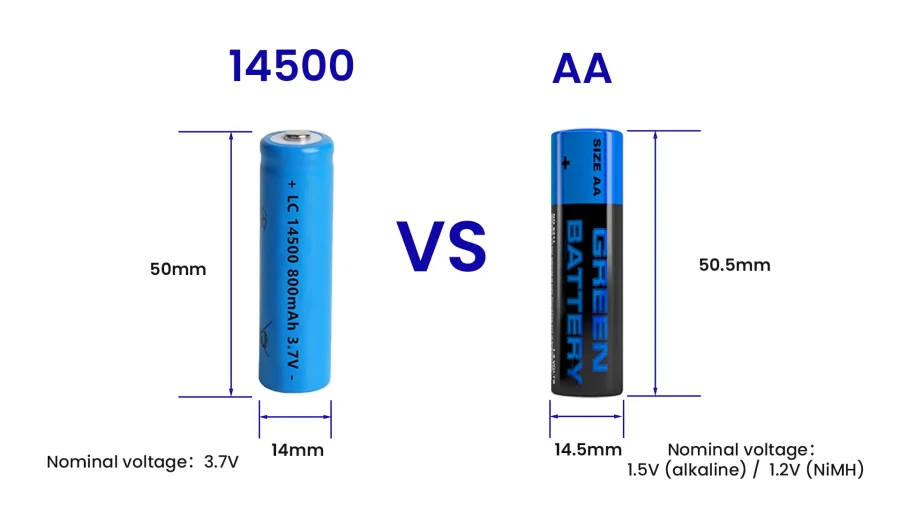
Some rechargeable lithium-ion cells are manufactured in the exact same physical dimensions as an AA battery — these are called 14500 Li-ion cells, and they deserve special attention because they are not a drop-in AA replacement despite fitting the same compartment.
| Specification | 14500 Li-ion | Standard AA |
| Diameter | 14.0 mm | 14.5 mm |
| Length | 50.0 mm | 50.5 mm |
| Nominal voltage | 3.7V | 1.5V (alkaline) / 1.2V (NiMH) |
| Typical capacity | 700–1,000 mAh | 800–3,000 mAh (chemistry-dependent) |
Critical safety note: a 14500 cell outputs more than double the voltage of a standard 1.5V AA battery. Using one in a device designed for 1.5V AA cells can damage the device’s circuitry or create a safety hazard. These cells are intended exclusively for devices explicitly engineered and labeled for 3.7V — most commonly specialty flashlights and certain DIY electronics projects. Always confirm your device’s rated voltage before ever using a 14500 cell in an AA-sized compartment.
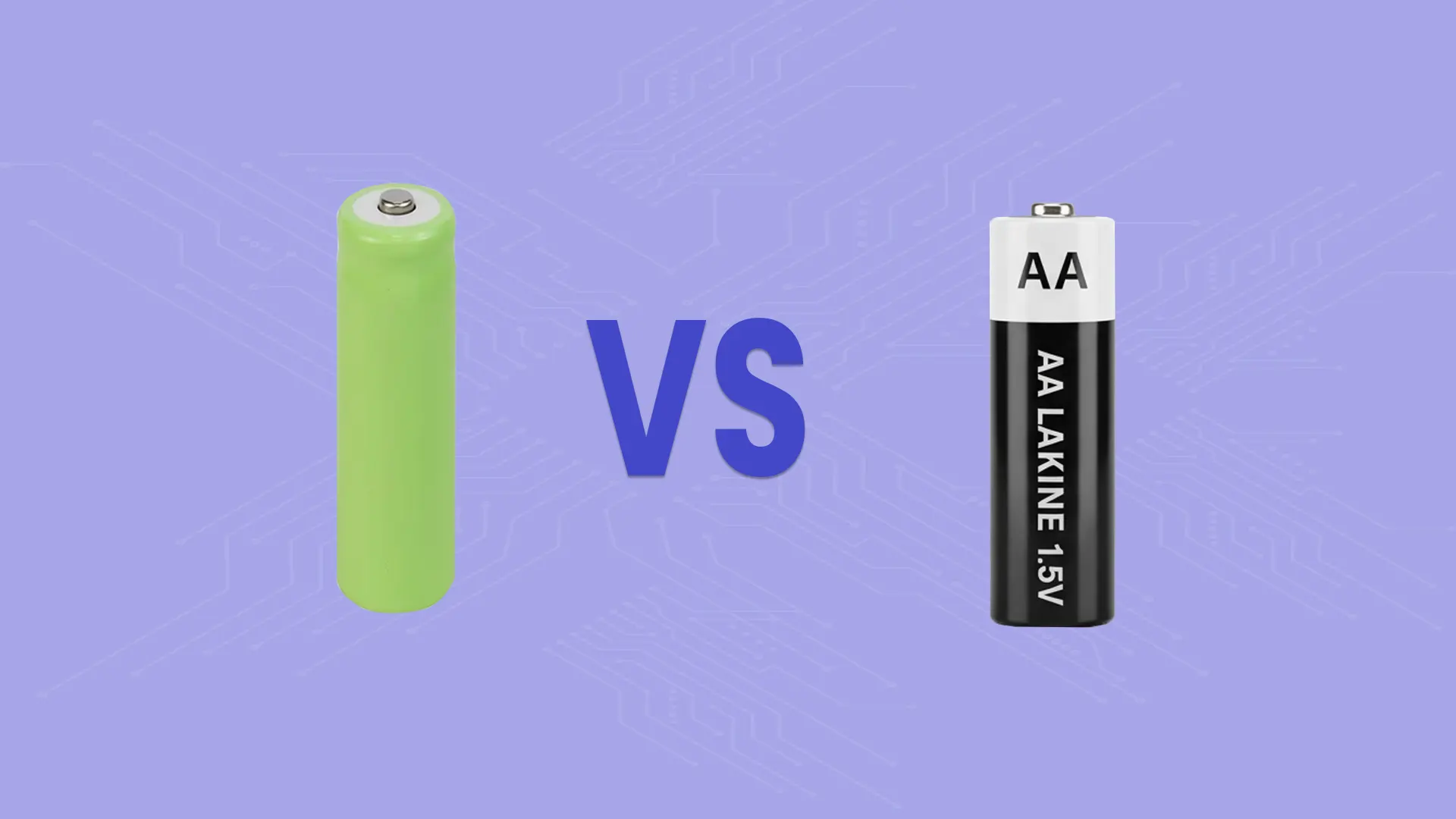
This article will explore in depth the differences between 14500 batteries and AA batteries in terms of size, chemical composition, energy density, rechargeability, and applications.
Which AA Battery Should You Choose?
Use this decision framework instead of defaulting to whatever’s cheapest on the shelf:
- If your device is used occasionally and draws low, steady current (wall clock, spare remote, smoke detector) → standard alkaline is the most practical, economical choice.
- If you replace batteries in the same device two or more times per year (wireless mouse, game controller, kids’ toys) → NiMH rechargeables typically pay for themselves within 6–12 months.
- If your device operates outdoors below ~40°F (5°C), sits unused for years at a time, or needs bursts of high current (winter photography, emergency equipment) → lithium iron disulfide (Li-FeS₂) is the chemistry built for exactly this.
- If your budget is the primary constraint and the device barely draws any power (novelty item, promotional gadget) → zinc-carbon will do the job at the lowest cost.
- If your product needs sustained high current, a non-standard voltage, or extreme cycle life (robotics, industrial sensors, power tools) → none of the above is the right answer; a custom lithium-ion battery pack, engineered for your actual current and voltage requirements, is what the application calls for.
Cost & Sustainability: Alkaline vs. NiMH Over 5 Years
For the two most commonly compared chemistries, here’s what the numbers typically look like over a 5-year period for a moderately used device (2–3 battery changes per year):
| Category | Alkaline (5 Years) | NiMH Rechargeable (5 Years) | Reduction with NiMH |
| Battery waste | ~920 g (≈40 units) | ~108 g (≈4 units) | ~88% less waste |
| Packaging waste | ~50 g | ~5 g | ~90% less waste |
| Total waste | ~970 g | ~313 g | ~68% less waste |
| Approx. cost over 5 years | Higher (recurring purchases) | Lower — savings of roughly $25 per battery slot over the period | — |
These figures are industry-typical estimates; actual savings and waste reduction will vary with your specific usage pattern and local battery pricing.
Common Devices That Use AA Batteries
- Digital cameras and camera flashes
- Flashlights and headlamps
- Motorized and electronic toys
- Wireless game controllers
- Portable speakers
- Wireless keyboards and mice
- Glucose monitors and portable blood pressure monitors
- Smoke detectors and emergency radios
AA Batteries Safety & Storage Best Tips
- Never mix old and new batteries, or different chemistries, in the same device.
- Store batteries at room temperature, away from metal objects that could cause a short circuit.
- Remove batteries from devices that will sit unused for extended periods to prevent leakage damage.
- Don’t puncture, incinerate, or short-circuit any AA battery — alkaline and NiMH cells contain potassium hydroxide, and NiMH specifically also contains metal hydride compounds, both hazardous if released.
- Never use a 3.7V 14500 cell in a device rated for standard 1.5V AA batteries.
- Dispose of used batteries responsibly through retailer take-back programs or municipal e-waste/battery recycling centers rather than household trash.
Beyond AA: When Consumer Cells Aren’t Enough
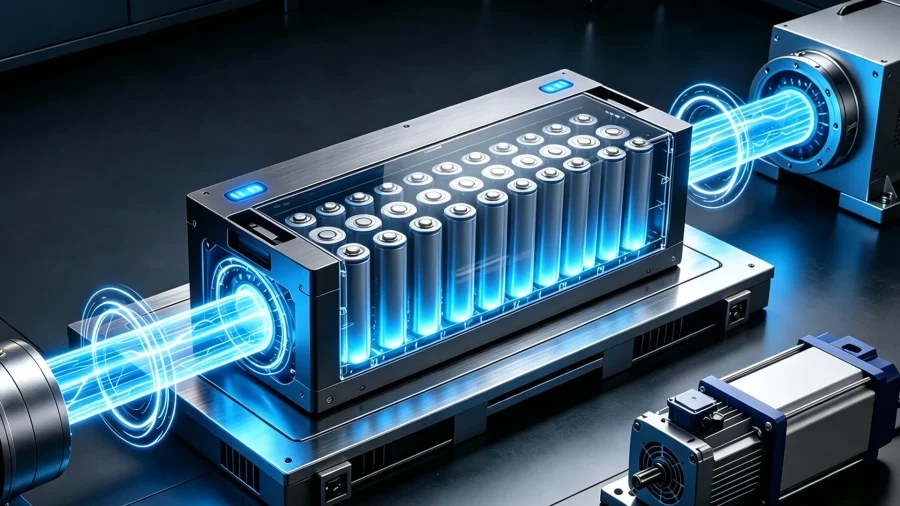
Every chemistry above — even high-capacity NiMH or premium lithium — is engineered for consumer-scale power demands.
For industrial, robotics, IIoT, and other applications needing sustained high discharge current, precise voltage control, or thousands of charge cycles, ordinary AA cells hit their ceiling soon.
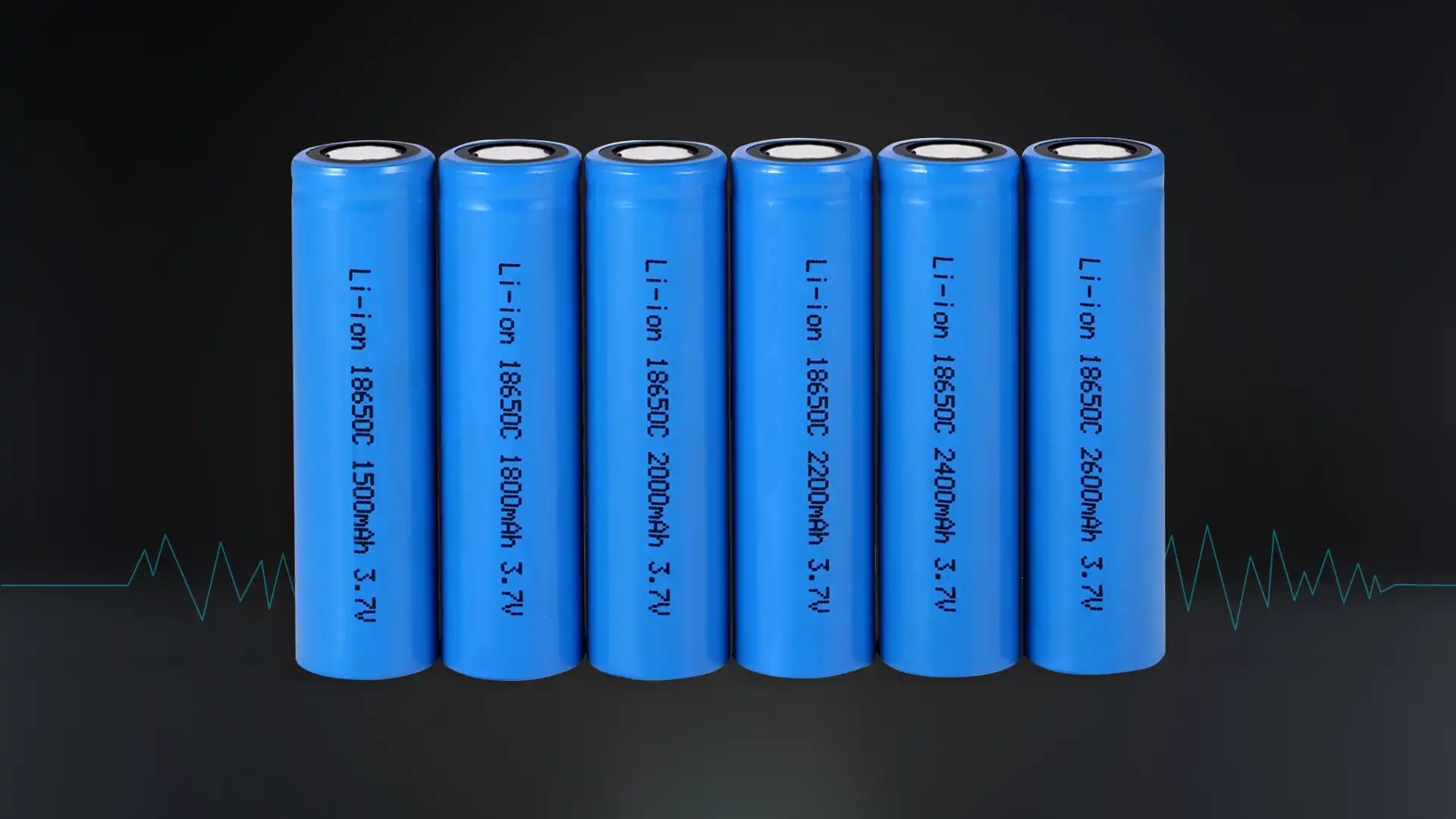
Custom lithium-ion battery packs (built from cylindrical cells like 18650 or pouch cells in engineered series/parallel configurations) provide higher energy density, purpose-built battery management systems (BMS), and cycle lives that can exceed 2,000–5,000 charges depending on chemistry — a meaningfully different performance tier from any off-the-shelf AA cell.
FAQ
What does “AA” stand for in battery sizes?
It doesn’t stand for words — AA is a standardized size designation under ANSI/IEC that defines physical dimensions and general electrochemical family, not a specific brand or performance level.
What’s the difference between alkaline, NiMH, and lithium AA batteries?
Alkaline is single-use, inexpensive, and suited to general household use. NiMH is rechargeable and more economical for frequently used devices. Lithium (Li-FeS₂) is single-use but performs best in cold weather and high-drain bursts, at a higher cost.
What is the difference between AA and AAA batteries?
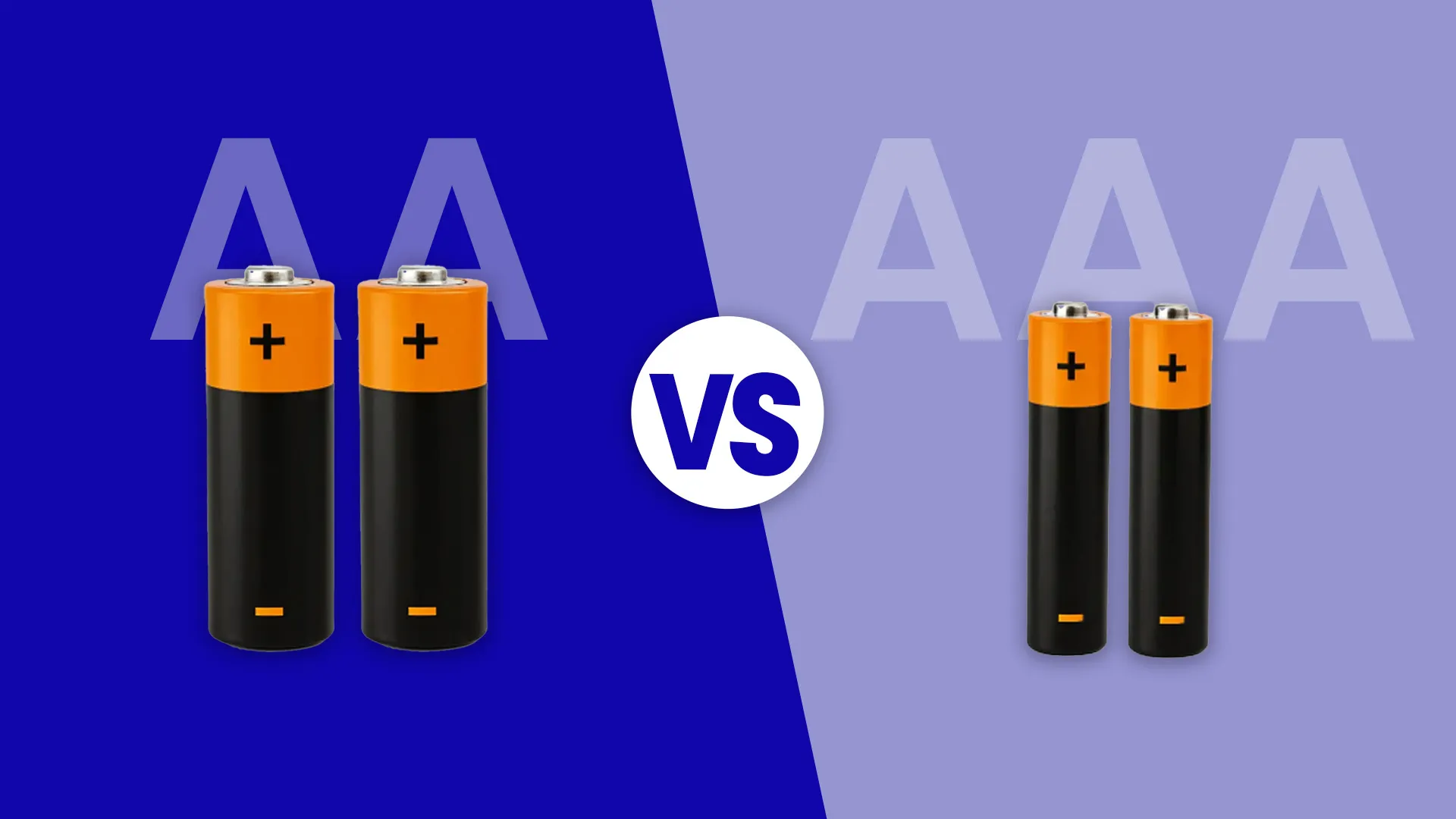
AA batteries measure 14.5 mm × 50.5 mm; AAA batteries measure 10.5 mm × 44.5 mm. AA batteries hold roughly 2–3 times more capacity and are not physically interchangeable with AAA. For more details, please refer to this article explaining the differences between AA and AAA batteries.
Are rechargeable AA batteries compatible with any device?
Most devices accept 1.2V NiMH rechargeables without issue, but some low-voltage cutoff circuits (certain smoke alarms or older remotes) may misread 1.2V as a low-battery signal. Check your device’s manual if you’re unsure.
How long do NiMH AA batteries last before needing replacement?
Quality NiMH AA cells typically deliver 500–1,500 charge cycles before capacity noticeably declines, translating to several years of use for most devices.
Can I use a 14500 lithium battery in a device designed for AA?
Not unless the device is specifically rated for 3.7V. A 14500 cell fits the AA compartment physically but outputs more than double the voltage of a standard AA battery, which can damage voltage-sensitive electronics.
Is it worth switching from alkaline to NiMH rechargeable AA batteries?
Yes, if you replace batteries in the same device two or more times a year. For occasional-use devices like an emergency flashlight, standard alkaline — or lithium if cold weather is a factor — remains simpler and often more cost-effective.
Why would anyone use lithium AA batteries instead of alkaline if they cost more?
Because in cold temperatures or high-drain bursts, lithium (Li-FeS₂) significantly outperforms alkaline — the higher price buys reliability in conditions where alkaline genuinely struggles.






One thought