Quick Answer
Waterproof battery pack testing is the set of leak, immersion, pressure and ageing tests used to confirm that a sealed pack keeps water out at its declared rating. Because an IP rating covers one test on one sample, we verify in layers: a leak test on every batetry pack in production, immersion or pressure-chamber testing at the rated depth, thermal cycling and vibration applied before immersion, and an independent report from a qualified laboratory when a customer or certifier requires one.
Key Takeaways
- Leak testing screens every battery pack; immersion validates the design. An air test is fast and sensitive, but a pass does not guarantee a pass in water.
- The order matters. For reliability validation we run thermal cycling, then vibration, then immersion, so the water test happens after the seal has aged.
- There is no universal leak limit. It is set per product from good-part baselines and deliberate micro-leak samples.
- A rating without conditions is incomplete. Ask for depth, duration, configuration and test sequence.
- The application sets the emphasis. For subsea battery packs, depth and duration drive the validation; for outdoor industrial battery packs, long sealed deployment and temperature swings do.
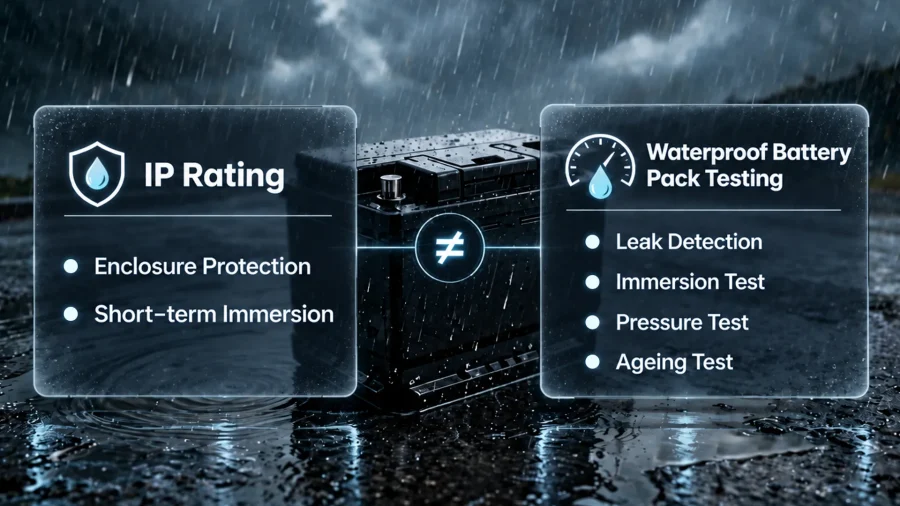
Why an IP Rating Alone Is Not Proof of a Waterproof Battery Pack
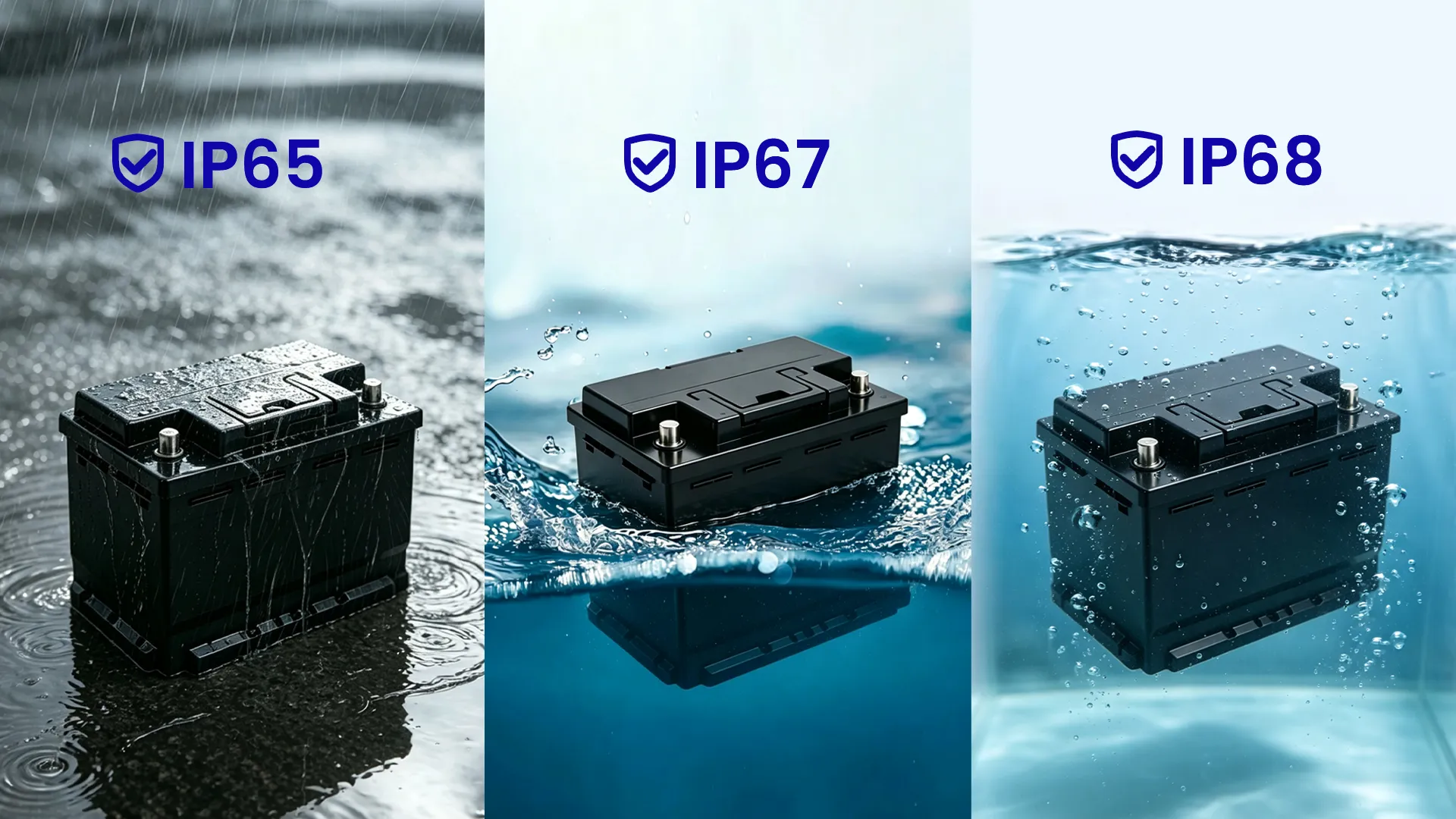
An IP rating classifies how well an enclosure resists solids and water, and gives no guarantee about the next unit or the seal’s condition years later. The code is defined in IEC 60529 and explained in our guide to IP ratings for waterproof lithium battery packs. The water digit 7 has a fixed test: immersion to 1 m for 30 minutes. For digit 8, depth and duration are agreed between manufacturer and user and must be more severe than for 7.
That leaves two gaps. First, a rating describes the sample that was tested, not every battery pack that ships. Second, the standard’s water test is generally described as a type test on a new product, so it does not show how a seal behaves after fatigue. The rest of this article shows how we address both.
The same code can hide very different test conditions. Two of our IP68 battery pack projects show it:
| Pack | Rating | Test condition |
| 12.8 V 105 Ah subsea robotics battery pack | IP68 | 5 m, 3 h |
| 12.8 V 50 Ah outdoor industrial IoT battery pack | IP68 | 1 m, 6 h |
| Standard temporary immersion (IPX7) | IPX7 | 1 m, 30 min |
Leak Test vs IP Test
The two tests are often confused. They answer different questions.
| Leak test | IP Rating test | |
| Medium | Air pressure (or vacuum) | Water |
| Measures | Pressure change or leak rate | Whether harmful water enters after exposure |
| Speed | Seconds to minutes, so it suits every unit | Longer, so it suits samples and design validation |
| Purpose | Production screen | Design verification |
| Basis | Method-based; the limit is set per product | IEC 60529, with defined conditions per rating |
Waterproof Battery Test Matrix: What Each Test Catches
Each test answers a different question. The table shows what each verifies, the standards family usually referenced, and where it sits in our process.
| Test | What it verifies | Standards family typically referenced | What it catches | Where it sits |
| Leak test (pressure decay) | Every pack’s seal integrity | Method-based; limits set per product | Missed sealant, uneven seal compression, housing micro-cracks, uneven screw torque | Production, every pack; also development |
| IP immersion | Temporary-immersion protection | IEC 60529, IPX7 | Gross seal failure, interface leaks | Design validation |
| Pressure chamber | Protection at rated depth and duration | IEC 60529, IPX8 (declared conditions) | Leaks that only appear under sustained pressure | Design validation |
| Thermal cycling | Seal behaviour after repeated expansion and contraction | IEC 60068-2-14 (Test N) | Micro-gaps in housing, sealant, gaskets | Before vibration and immersion |
| Vibration | Seal behaviour after mechanical stress | IEC 60068-2-6 (Test Fc), IEC 60068-2-64 (Test Fh) | Loosening, cracking of already-weakened seals | After thermal cycling, before immersion |
| Salt spray | Corrosion at metal interfaces | IEC 60068-2-11 (Test Ka), IEC 60068-2-52 (Test Kb) | Corrosion at fasteners, terminals, dissimilar-metal joints | Design validation |
Test profiles depend on the battery pack application. A waterproof battery pack for an agricultural robot and one for a subsea vehicle see different stresses, so a supplier should be able to state the profile behind its claim.
Battery Pack Leak Testing for Waterproof Packs: Pressure Decay in Practice
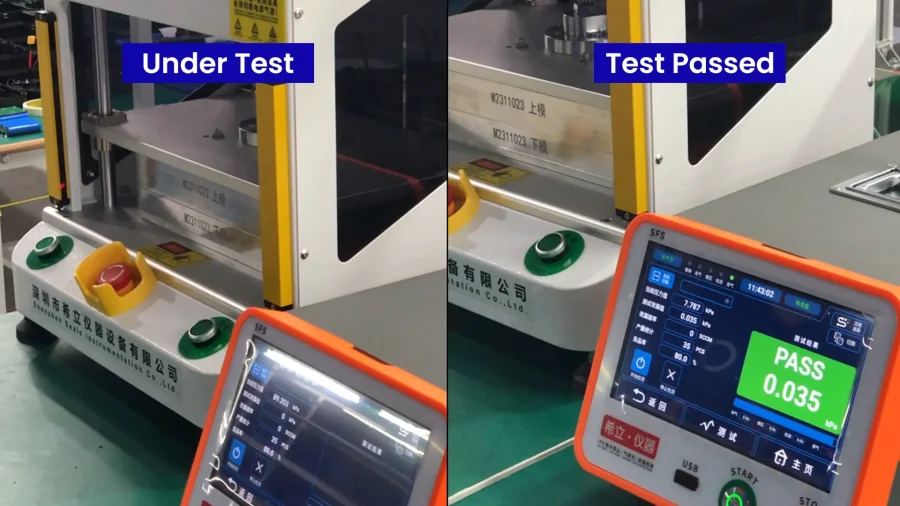
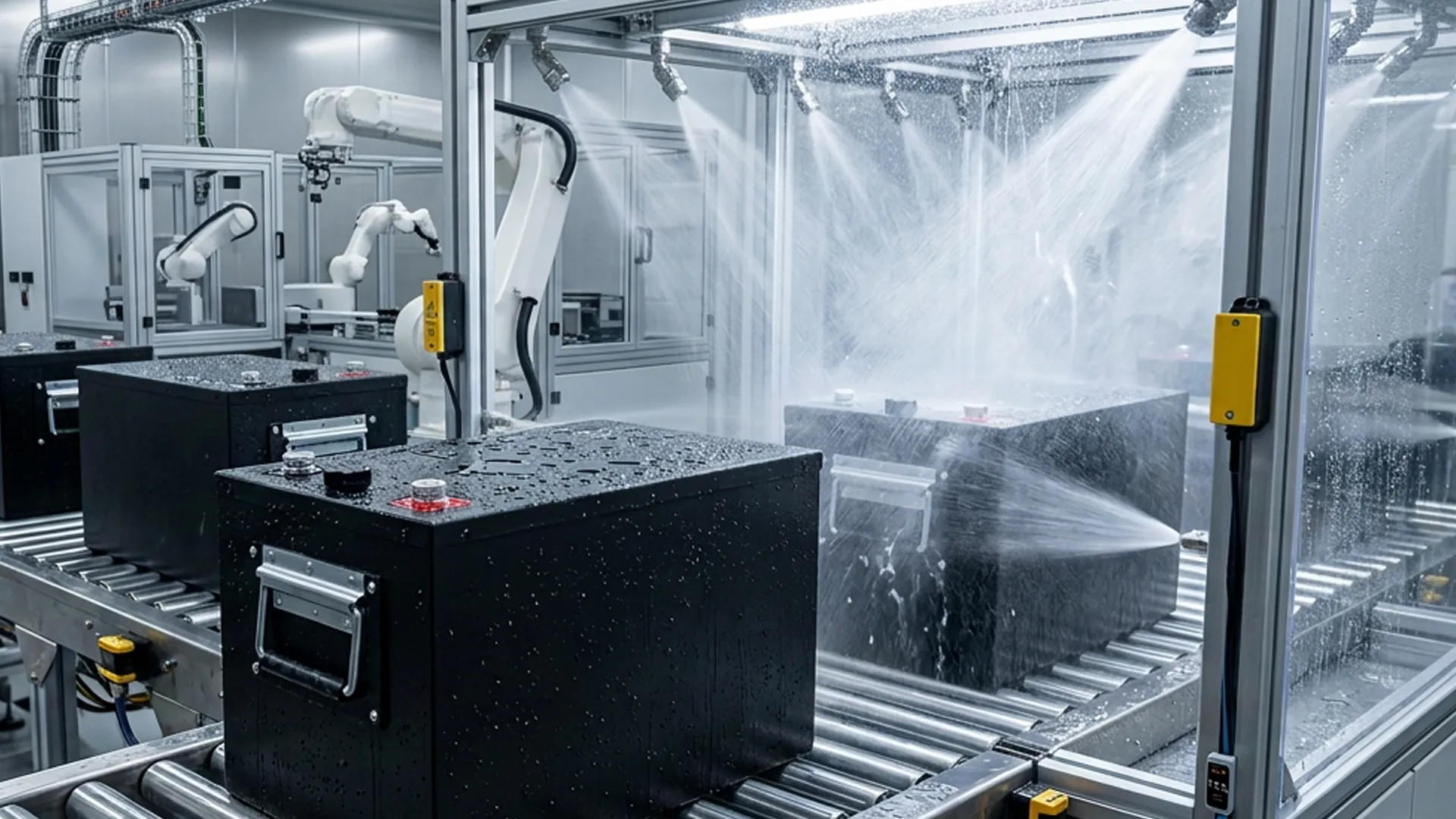
A pressure decay test fills the battery pack with air to a set pressure, isolates it, and measures how fast the pressure falls. It is the test that most often exposes problems in development and production, and it is our default screen for every pack.
Why We Leak-Test Every Battery Pack
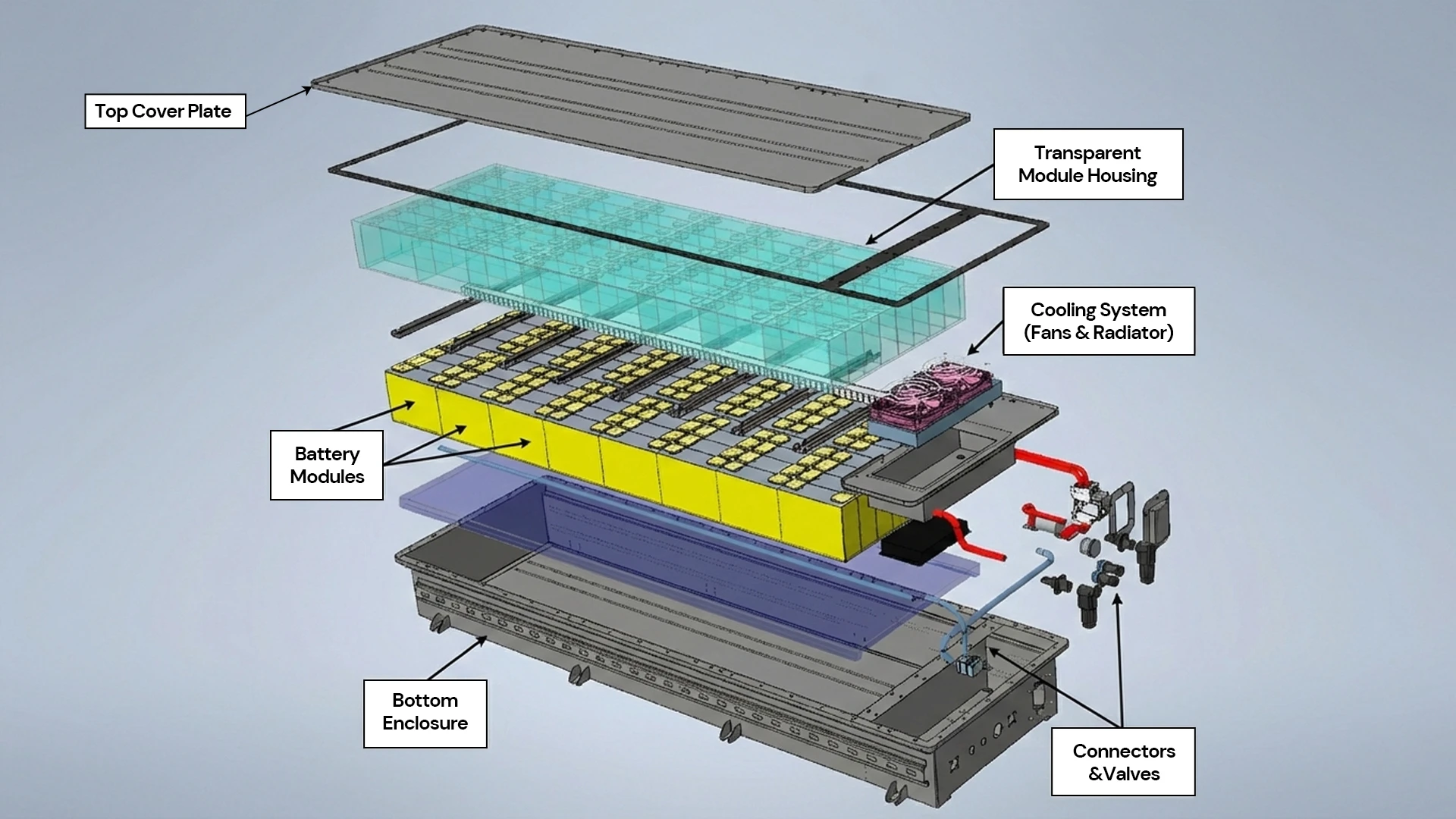
Wang Huahan, our CTO, explains why. A leak test is sensitive to small leaks that are hard to see in water: missed sealant, unevenly compressed seals, small housing cracks, even uneven screw locking can show up directly as a pressure drop. Waterproof battery packs are structurally complex, and harness exits, high-voltage connectors, pressure-relief valves and breather membranes are the places where sealing problems tend to appear. The test is also fast enough for in-line judgement, which is why we recommend testing every battery pack rather than sampling.
It does a second job. A drifting leak-test result is often the first sign that an assembly step has stopped being stable, so the test verifies the process as well as the product.
How a Pressure Decay Test Works
The sequence has four stages: fill, stabilise, measure, vent. The measured pressure drop, ΔP, converts to a leak rate through the battery pack’s free internal volume:
Q ≈ (V × ΔP) / (P_atm × t)
This is why a limit quoted in pascals means little without volume and time. As arithmetic illustration only, not a CMB specification: a battery pack with 20 L of free volume that loses 30 Pa in 30 seconds is leaking about 12 mL/min at atmospheric pressure, while the same 30 Pa in a 2 L battery pack is about 1.2 mL/min.
Leak Test Methods Compared
| Method | How it works | Strength | Limit |
| Positive-pressure decay | Pressurise, isolate, watch for a drop | Fast, most common | A thin-walled battery pack can expand slightly under pressure |
| Negative-pressure (vacuum) decay | Draw a partial vacuum, watch for a rise | Loads the seal in the same direction as external water pressure | A battery pack can contract slightly under vacuum |
| Differential pressure decay | Compare against a reference volume | Reduces sensitivity to temperature drift | Needs a matched reference |
| Tracer gas (helium or similar) | Detect escaping tracer gas | Finds very small leaks | Slower and costlier; vacuum-based helium methods can stress cells, which is why accumulation methods at atmospheric pressure have been proposed |
| Water immersion (bubble check) | Submerge and watch | Shows leak location visually | Slow and less sensitive to micro-leaks |
How the Pass Limit Is Set and What Disturbs a Reading
There is no number that fits every product. The limit depends on the product’s volume, structure and target IP level, and is established by testing:
- Measure a batch of battery packs confirmed leak-free to build a baseline, the normal pressure fluctuation of a good product.
- Make representative micro-leak samples.
- Establish the test window between good and defective battery packs.
- Set the production NG limit with equipment accuracy, temperature change, cavity volume and a safety margin taken into account.
So the number is not lifted from an industry table. It comes from product validation and boundary-sample testing.
What Disturbs a Leak Reading
Three factors especially affect results, according to Wang: a product still warm from welding, housing deformation under pressure, and large internal-volume differences between products. Common countermeasures are letting the battery pack cool or compensating for temperature, using clamping fixtures and longer stabilisation for flexible housings, and choosing differential or tracer-gas methods for large cavities.
IP67 Immersion and IP68 Pressure Chamber Testing
IP67 testing means immersion in water at 1 m for 30 minutes. IP68 testing uses a deeper or longer condition agreed for the application. Either way, the depth and duration must be stated, because they are what the test actually proves.
Watch Our IP67 Immersion Test
Immersion is the test buyers recognise, so we filmed it. The video shows a CMB 12 V 100 Ah battery pack held under 1 m of water for 30 minutes with no bubble leakage, then shows the pack discharging in a humid environment and working normally after the one-metre test. It is an in-house test, and we label it as one. The pack’s full specification is on our waterproof battery pack page.
Watch the video below to see the IP67 immersion test in action, followed by a post-test discharge check.
Why Air Testing Does Not Replace Water Testing
A battery pack that passes an air test can still fail in water. Wang confirms it happens in real projects. Air testing is sensitive to small leaks, so it often finds problems before the pack is ever submerged. But air and water tests are not the same environment: water’s surface tension, immersion depth, the battery pack’s orientation, and the state of some seal structures once pressurised or deformed can all change the outcome. Air is the right quick screen in production. Final waterproof capability is confirmed by immersion or IP testing.
Independent sources agree. A European patent on battery-pack leak detection states that conventional gas detection is affected by ambient temperature change and battery pack volume change and may lack the precision that IP67 and IP68 demand. Engineers writing on EV battery pack sealing likewise note that a calculated allowable leak rate still needs confirming by submersion.
Pressure Chamber Testing for Depth
Beyond 1 m, a battery pack is tested in a pressure chamber, where water is pressurised to the hydrostatic load of the declared depth. One metre of fresh water exerts about 9.8 kPa; five metres exerts about 49 kPa. Our 12.8 V 105 Ah subsea battery pack is rated IP68 at 5 m for 3 hours. A pressure chamber applies static pressure for a set time. It is a simulation, and we describe it as one. Footage of chamber runs is available on request during technical review.
Thermal Cycling, Vibration and Salt Spray Before Immersion
For reliability validation, we run thermal cycling first, then vibration, then immersion. The aim is to put the product through the heat and mechanical stress of real use before checking its waterproof capability.
Thermal cycling makes the battery housing, sealant and gaskets expand and contract repeatedly. Vibration then acts on the seals that thermal cycling has weakened, and weak points may loosen or crack further. Immersion at the end verifies that the battery pack still holds after that stress history. Running the tests separately would miss the interaction, and immersion on a fresh battery pack flatters the result.
This sequence is stricter than the minimum in the IP standard. The environmental methods behind it are published in the IEC 60068-2 series: Test N for change of temperature (IEC 60068-2-14), Test Fc for sinusoidal vibration (IEC 60068-2-6) and Test Fh for broadband random vibration (IEC 60068-2-64).
Salt spray tests something different: corrosion at fasteners, terminals and dissimilar-metal interfaces, which can eventually open a leak path of its own. IEC 60068-2-11 (Test Ka) is the continuous salt-mist method and IEC 60068-2-52 (Test Kb) is the cyclic one.
Connectors, Vents and Cable Entries: Interfaces Are Tested Too
A battery pack is only as sealed as its weakest opening, and the openings are harness exits, high-voltage connectors, pressure-relief valves and breather membranes. Two details matter for testing.
A connector’s protection differs mated and unmated, which we cover in our article on waterproof connectors and disconnect switches, so a test must state which condition applies. And a breather membrane passes air by design, so an air-test fixture has to plug it or account for it. That is one reason immersion cannot be dropped.
What a Failed Leak Test Means
A failed leak test is a location and a process signal, not only a verdict. The table maps the defects Wang names to the test that exposes them and the design layer involved.
| Defect | Exposed by | Design layer involved |
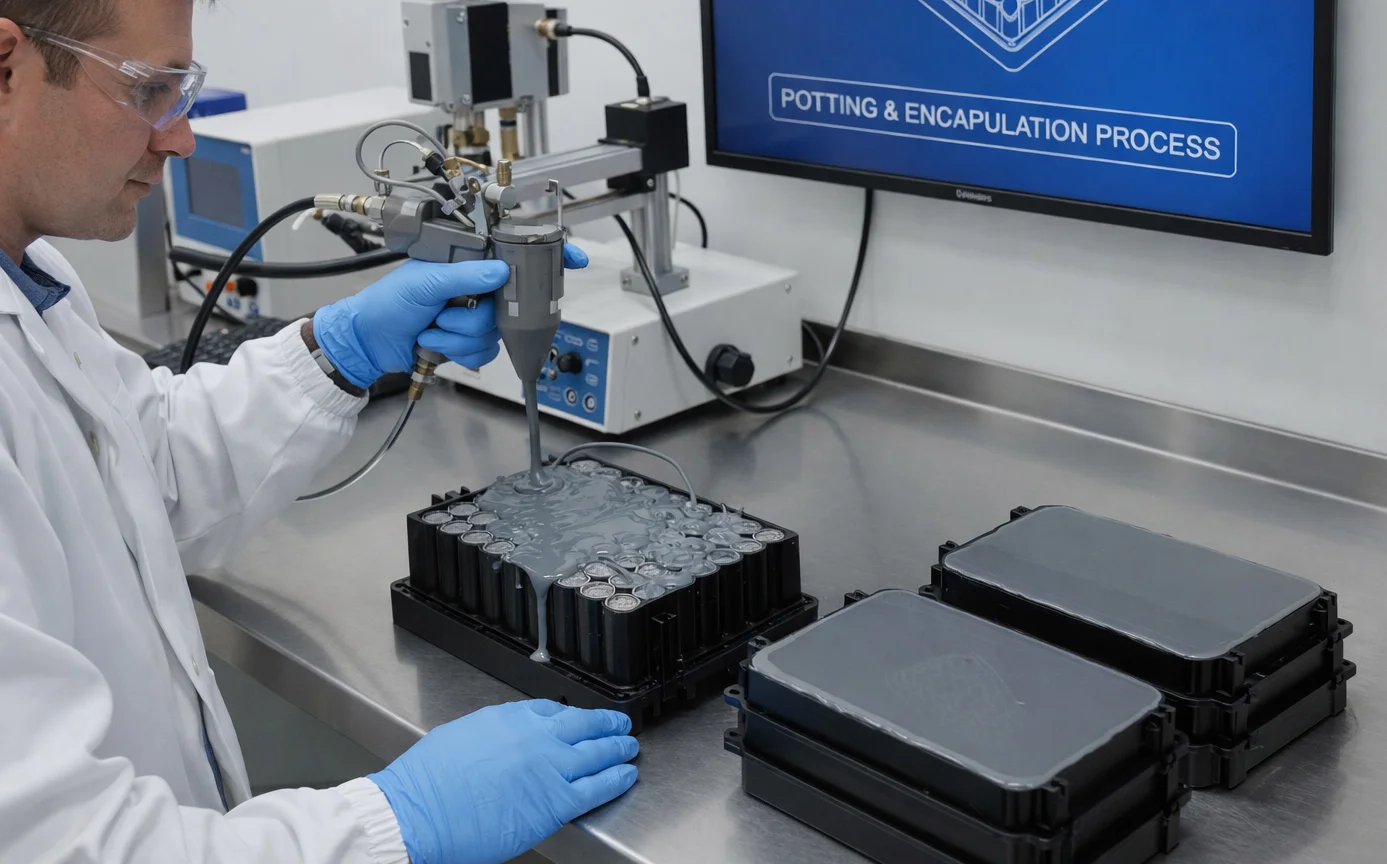
| Missed or incomplete sealant | Leak test | Sealant and potting |
| Unevenly compressed seal | Leak test | Gaskets and O-rings |
| Small crack in the housing | Leak test; vibration stress | Housing and seams |
| Uneven screw locking | Leak test | Fastening and torque control |
| Leak at harness exit, connector, relief valve or breather | Leak test and immersion | Interfaces |
The design choices behind these layers are covered in our guide to sealing architecture and material selection. What water does to the cells once it gets in is a separate problem, described in our article on what happens when a lithium-ion battery is submerged.
Production Testing vs Design Validation
Production testing catches unit-to-unit variation; design validation proves the design. They answer different questions, so both are needed.
| Stage | What runs | Where | Purpose |
| Design validation | Immersion or pressure chamber, ageing sequence | In-house first, then a qualified external laboratory when needed | Prove the design and produce independent evidence |
| Production | Leak test on every battery pack | Production line | Catch unit-to-unit and process variation |
The two laboratories are not either-or. In development we prefer to validate in-house: it is efficient, and a problem can be fixed in the structure or sealing scheme and re-tested immediately. For customer delivery, certification, or any requirement for a third-party report, we use a qualified external laboratory. In-house testing drives quick iteration; third-party testing provides the final independent verification and report. This work sits within our wider reliability test framework
Which Verification Layers Matter Most by Application
The layers above are not weighted equally for every pack. The table is general guidance for buyers, not CMB acceptance criteria.
| Application | What usually drives the validation | Layers to weigh most |
| Underwater and subsea packs (ROVs, AUVs, sensors) | Depth, duration and seawater exposure | Pressure chamber at the declared depth; salt spray for metal parts; connector state during the test |
| Outdoor industrial IoT | Long sealed deployment and day-to-night and seasonal temperature swings | Thermal cycling before immersion; a leak test on every pack; immersion duration |
| Agricultural and mobile robots | Vibration, mud and rough handling | Vibration before immersion; cable-entry and connector tests; IP67 immersion |
How to Audit a Supplier’s Waterproof Battery Claim
Use this checklist for any supplier, including us.
- Rating with conditions. Ask for the depth, duration and water conditions behind the code. “IP68” alone is incomplete.
- Independent report. For delivery or certification, ask for a report from a qualified laboratory (for example one accredited to ISO/IEC 17025), with the report number.
- Same configuration. Check that the tested sample used the same housing, connectors, cable entries and breather as the battery pack you are buying.
- Test sequence. Ask whether ageing was applied before immersion or the battery pack was tested new.
- Connector state. Ask whether connectors were mated, capped or fitted with cables during the test.
- Production control. Ask whether every battery pack is leak-tested. Ask how the limit was established (good-part baseline and micro-leak samples), and request it with volume, test pressure and dwell time, not as a bare number.
- Reading disturbances. Ask how temperature, housing deformation and volume differences are handled.
- Calibration and traceability. Ask how the tester is checked and whether results are recorded per serial number.
- Witnessing. Ask to watch a test or review the raw curves.
If your project needs a specific verification plan, our verification & validation capabilities page explains how we scope it.
FAQ:
How Do You Test Whether a Battery Pack Is Waterproof?
Use layers. Screen every battery pack with an air leak test (pressure decay); validate the design by immersion at the declared depth and duration, or in a pressure chamber for deeper ratings; apply thermal cycling and vibration before immersion; and, for delivery or certification, get an independent report from a qualified laboratory. Always state depth, duration and connector condition with the result.
Is an Air Leak Test Enough to Prove a Battery Pack Is Waterproof?
No. An air leak test is a fast, sensitive production screen, but air and water are not the same environment. Surface tension, depth, battery pack orientation and seal deformation under pressure can change the outcome, so a pass in air does not guarantee a pass in water. Use air testing on every pack and immersion or pressure-chamber testing to confirm the design.
What Is the Difference Between a Leak Test and an IP Test?
A leak test uses air pressure to measure how much the sealed battery pack leaks and is fast enough for every unit. An IP test, defined in IEC 60529, exposes the pack to water under defined conditions and checks for harmful ingress. The first screens production; the second verifies the design.
What Leak Rate Is Acceptable for a Waterproof Battery Pack?
There is no universal figure. The limit depends on the battery pack’s volume, structure and target IP level, and is set from a good-part baseline and deliberate micro-leak samples, with allowance for equipment accuracy, temperature and safety margin. Treat any limit quoted without volume, pressure and dwell time as incomplete.
Why Do Waterproof Battery Packs Need Thermal Cycling and Vibration Before Immersion?
Because a new battery pack flatters the seal. Thermal cycling fatigues housing, sealant and gaskets; vibration then loosens or cracks the weakened points. Immersion afterwards shows whether the seal survives that stress history. The IP standard’s water test is generally applied to a new specimen, so this sequence is stricter than the minimum.
How Is an IP68 Battery Pack Tested?
IP68 means continuous immersion under conditions agreed between manufacturer and user, and more severe than IPX7’s 1 m for 30 minutes. The battery pack is tested at the declared depth and duration, in a tank or a pressure chamber that reproduces the hydrostatic pressure. The depth and duration should always be stated with the rating.
What Tests Does an Underwater Battery Pack Need?
At minimum: immersion or pressure-chamber testing at the declared depth and duration, a leak test on every pack, and thermal cycling and vibration before immersion. IP immersion tests use fresh water, so also ask for salt-spray or corrosion evidence for metal parts and connectors. Confirm that the depth, duration and connector state in the test match your mission.
Do I Need a Third-Party Report for a Waterproof Battery Pack?
For customer delivery, certification, or any independent verification, yes. In-house testing is valuable for development and production control, but a report from a qualified external laboratory provides independent evidence. Check that the tested configuration matches the battery pack you are buying.