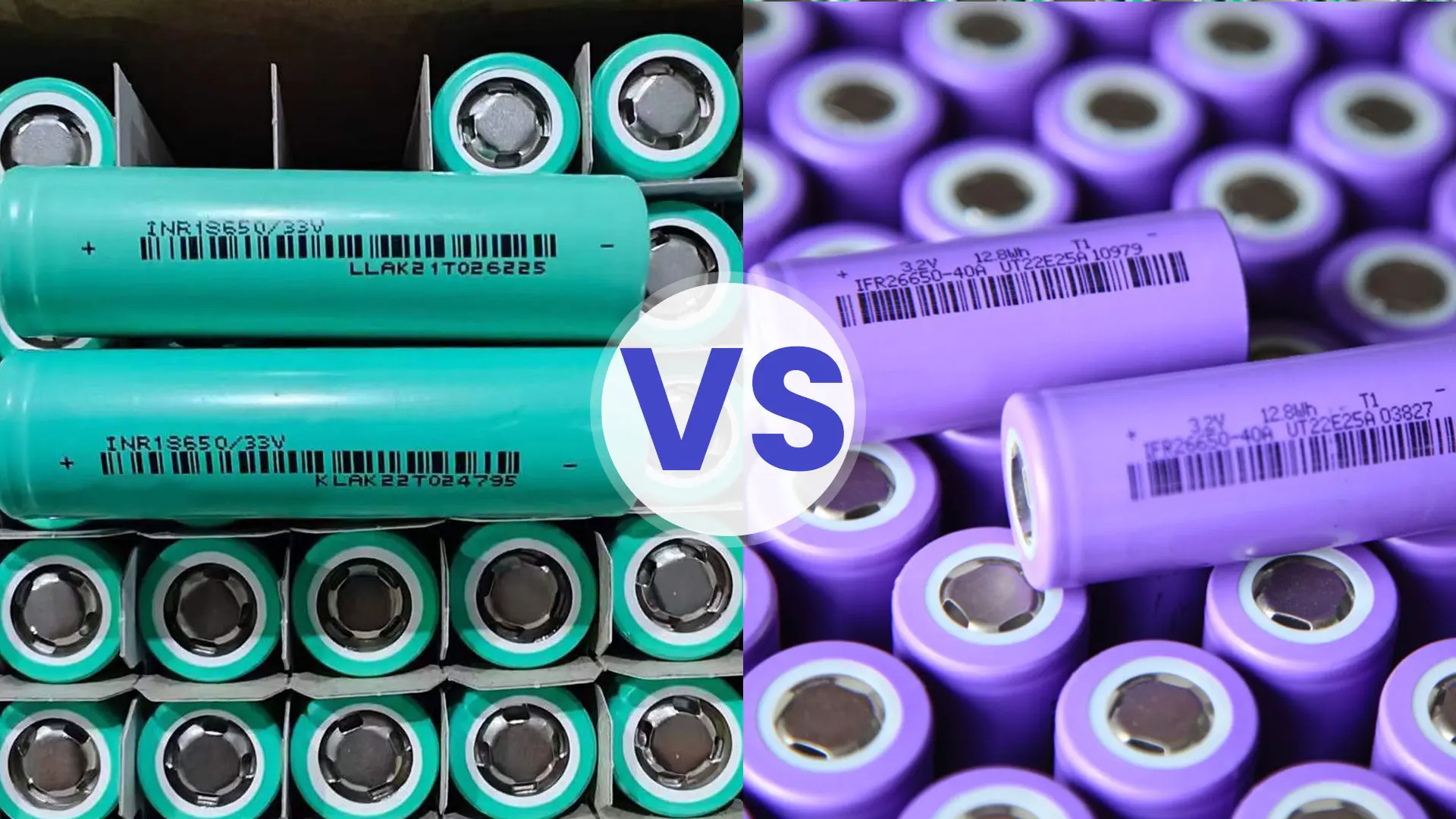
A 26650 battery is a cylindrical lithium-ion cell measuring roughly 26 mm in diameter and 65 mm in height, available in LiFePO4 (3.2V) or NMC (3.7V) chemistry. LiFePO4 26650 battery cells typically deliver 2,500–4,500 mAh, an energy density of 90–130 Wh/kg, and 2,000–7,000+ charge cycles depending on depth of discharge — making them a common choice for industrial IoT, outdoor security, and agricultural equipment.
Key Takeaways
- A 26650 battery is a cylindrical lithium-ion cell roughly 26.0–26.8 mm in diameter and 65.7–66.4 mm tall, available in LiFePO4 (3.2V) or NMC/ternary (3.7V) chemistry.
- LiFePO4 26650 battery cells realistically deliver 90–130 Wh/kg — not the 180 Wh/kg figure widely (and incorrectly) repeated online, which describes NMC chemistry instead.
- Cycle life depends on depth of discharge: expect 2,000+ cycles at 100% DOD, 4,000+ at 80% DOD, and 7,000+ at 50% DOD, each to roughly 80% capacity retention.
- Low-temperature-rated 26650 LiFePO4 battery packs can be engineered for reliable discharge down to -40°C — see the two real case studies below.
- Choosing the right cell is only half the job; pack-level decisions (series/parallel configuration, BMS protection, low-temperature charge derating, certification precision) determine whether a design holds up in the field.
This guide focuses specifically on the 26650 cell format. If you’re deciding between a 26650 and an 18650 cell for a new battery pack design, see our dedicated comparison of 18650 vs 26650 batteries for a side-by-side breakdown. Here, we go deeper into 26650-specific specifications, chemistry trade-offs, and the pack-design decisions engineers need to make before committing to a cell.
What Is a 26650 Battery?
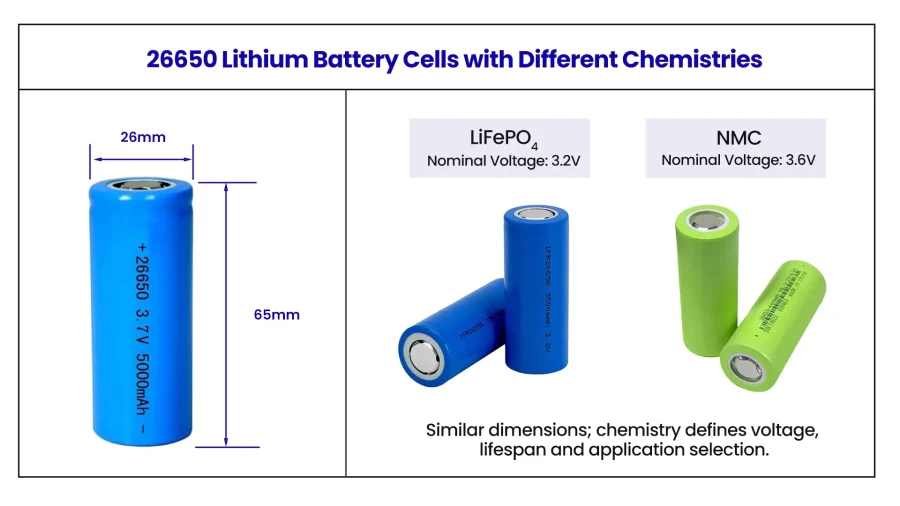
A 26650 battery is a rechargeable cylindrical lithium-ion cell identified by an IEC-style dimension code: the first two digits are the approximate diameter in millimeters, the following three digits are the approximate height in tenths of a millimeter, and the trailing “0” indicates a cylindrical shape. A cross-check of multiple publicly available 26650 cell datasheets shows outer dimensions typically ranging from 26.0–26.8 mm in diameter and 65.7–66.4 mm in height, with a manufacturing tolerance of roughly ±0.2 mm.
Two chemistries dominate the 26650 cell format:
- LiFePO4 (LFP) 26650 battery cells, nominally rated at 3.2V, prioritize thermal stability, cycle life, and safety margin — the default choice for industrial and outdoor equipment.
- NMC/ternary lithium 26650 battery cells, nominally rated at 3.6V, prioritize higher single-cell capacity and energy density, more common in consumer power tools and some Mobility applications.
A typical LiFePO4 26650 cell weighs approximately 82–96 g, depending on its capacity and discharge-rate design.
26650 Battery Specifications and Key Parameters
Every 26650 battery pack decision — cell count, BMS current rating, thermal management — starts from four cell-level parameters: capacity, discharge rate, cycle life, and internal resistance.
Capacity
LiFePO4 26650 battery cells optimized for energy typically range from 2500 mAh to 4500 mAh. Cells optimized for high continuous discharge trade capacity for lower internal resistance, typically landing in the 2500–3400 mAh range. NMC 26650 variants can reach 5000–7000 mAh at the cost of thermal margin.
Discharge Rate
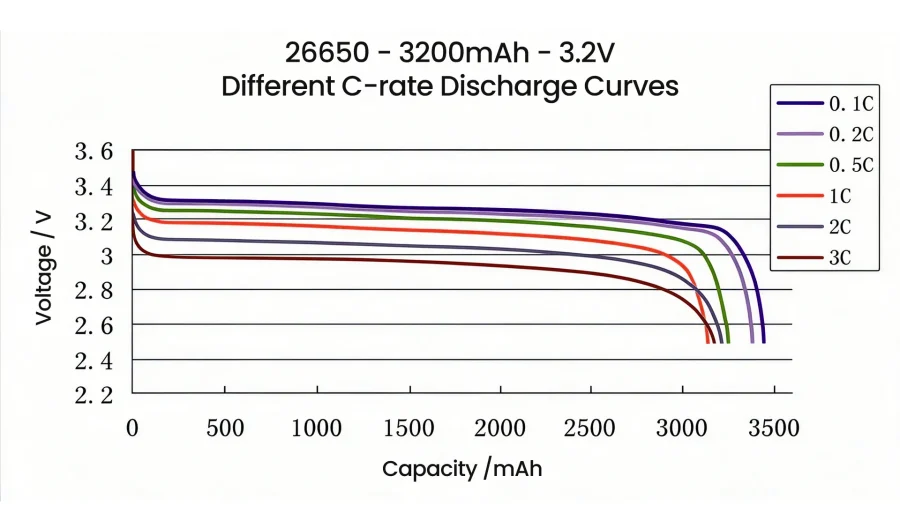
Standard energy-type 26650 LiFePO4 battery cells are rated for continuous discharge around 1C to 3C. Power-optimized designs — the same category used in the case studies below — support continuous discharge of 10C to 20C, with pulse ratings up to 30C–50C for short bursts. The right choice depends entirely on your load profile; our article on the role of C-rating in lithium-ion battery pack design explains how to translate a device’s current draw into a C-rating requirement.
Cycle Life
Cycle life isn’t a single number — it depends heavily on depth of discharge (DOD). Across the datasheets we cross-checked, a consistent pattern holds: 26650 LiFePO4 battery cells typically reach 2000+ cycles at 100% DOD, 4000+ cycles at 80% DOD, and 7000+ cycles at 50% DOD, each to roughly 80% of original capacity. A single “5000 cycles” headline figure, without stating the DOD it was tested at, tells you very little about real-world pack life.
Internal Resistance
Ranges from roughly 6 mΩ in high-rate designs to 25 mΩ in standard energy designs — lower resistance supports higher discharge current and less heat generation under load, at some cost to energy density.
A Note on Data Verification
The figures above reflect a cross-check of multiple publicly available 26650 cell datasheets by CMB’s engineering team, evaluated against test methods referenced in IEC 62133 and UN 38.3, rather than a single proprietary source. Where our own pack-level test data is available — as in the two case studies below — we call that out explicitly, consistent with the verification approach described in our reliability test framework.
| Data Category | Verification Status |
| Case study parameters (6.4V 16Ah pack; -40°C 12.8V 9.6Ah pack) | ✅ Verified — CMB internal project data |
| Dimensions, capacity, cycle life, and energy density ranges | ⚠️ Partially verified — cross-checked across multiple public 26650 datasheets, not tied to a single proprietary source |
| “Up to 180 Wh/kg” energy density claim seen elsewhere online | ❌ Flagged — inconsistent with LiFePO4 chemistry specifically; more representative of NMC cells |
Chemistry Options: LiFePO4 vs NMC in 26650 battery cells
| Chemistry | Nominal Voltage | Verified Energy Density | Cycle Life Pattern | Typical Use Case |
| LiFePO4 | 3.2V | 90–145 Wh/kg | 2,000–7,000+ cycles (DOD-dependent) | Industrial IoT, outdoor, security, agriculture |
| NMC/ternary | 3.6V | 150–230+ Wh/kg | 500–2,000 cycles (chemistry-typical) | Power tools, consumer electronics, some EV-adjacent uses |
You’ll often see “26650 LiFePO4 battery energy density up to 180 Wh/kg” repeated across battery blogs and product pages. However, that figure does not accurately represent conventional IFR26650 cylindrical LiFePO4 cells. It is more consistent with energy-density figures reported for larger-format prismatic LiFePO4 cells or battery systems, which use a different cell and packaging structure.
Based on commercially available 26650 cells, a more realistic range is around 90-145 Wh/kg, with high-capacity 4000mAh models reaching roughly 145 Wh/kg at the cell level. If your design relies on LiFePO4’s safety, long cycle life, and thermal stability, use this realistic range when estimating pack weight and runtime rather than applying the 180 Wh/kg figure directly.
For high-power applications, prioritize low-resistance, high-rate cells; for longer runtime, higher-capacity energy cells may be more suitable. For a broader primer on why LiFePO4 is the default choice for industrial pack designs, see our complete guide to LiFePO4 batteries.
26650 vs Other Cylindrical Cell Sizes
| Format | Approx. Diameter × Height | Typical LiFePO4 Capacity | Common In |
| 18650 | 18 mm × 65 mm | 1,500–3,600 mAh | Laptops, portable electronics, smaller battery packs |
| 21700 | 21 mm × 70 mm | Higher per-cell capacity than 18650, chemistry-dependent | Power tools, EV-adjacent applications |
| 26650 | 26.0–26.8 mm × 65.7–66.4 mm | 2,500–4,500 mAh | Industrial IoT, outdoor equipment, high-drain tools |
For a full breakdown of when to choose an 18650 over a 26650 (and vice versa), see our 18650 vs 26650 battery comparison.
What Are 26650 Batteries Used For?
The 26650 battery format shows up wherever a design needs more capacity or discharge current per cell than an 18650 can deliver, without moving to a larger prismatic or pouch format. Common applications include:
- Industrial IoT sensors and gateways that need multi-year field life without frequent battery swaps
- Outdoor security and monitoring equipment deployed off-grid, where low-temperature performance directly affects field reliability
- Agricultural robotics and machinery operating in dusty, vibration-heavy, temperature-variable environments
- Portable industrial tools and instruments that need sustained high discharge current
Case Study: Solving Overnight Power Loss in Outdoor Security Cameras
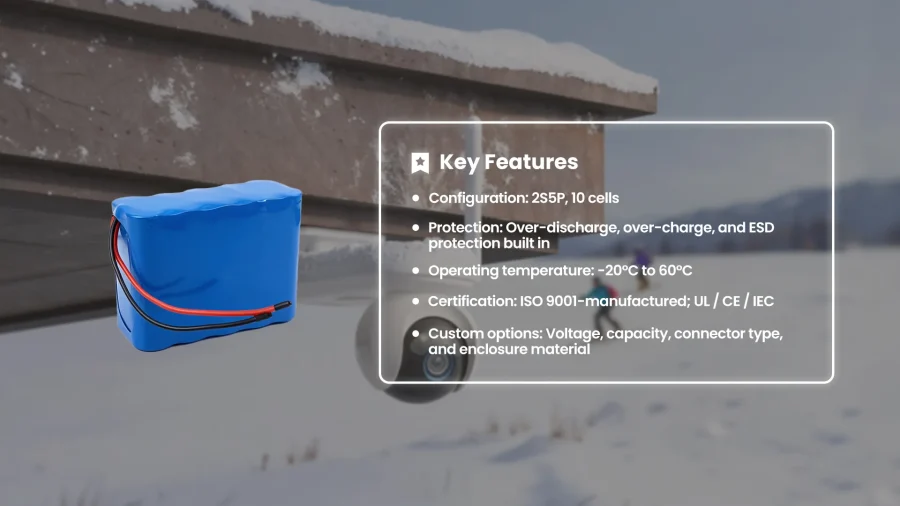
An outdoor security-equipment manufacturer came to CM Batteries after units at remote, off-grid monitoring sites began losing power overnight as ambient temperatures fell — and the customer’s existing low-temperature battery pack was too large for a camera housing already tooled for production.
CM Batteries traced the failure to usable capacity dropping sharply once temperatures approached -20°C, then rebuilt the pack around low-temperature-rated 26650 LiFePO4 battery cells validated for -20°C to 60°C operation. A compact 2S5P configuration (10 cells) in a low-profile PVC heat-shrink jacket matched the original pack’s footprint with no housing changes, while built-in over-discharge, over-charge, and ESD protection addressed the exposed outdoor wiring risk. The result was a validated 6.4V 16Ah 2S5P low-temperature LiFePO4 battery pack that held usable capacity through overnight cold without a housing redesign.
26650 Battery Pack Design Considerations
Selecting a cell is only step one. Turning a 26650 cell into a reliable pack for a customer product involves decisions the cell datasheet alone won’t answer:
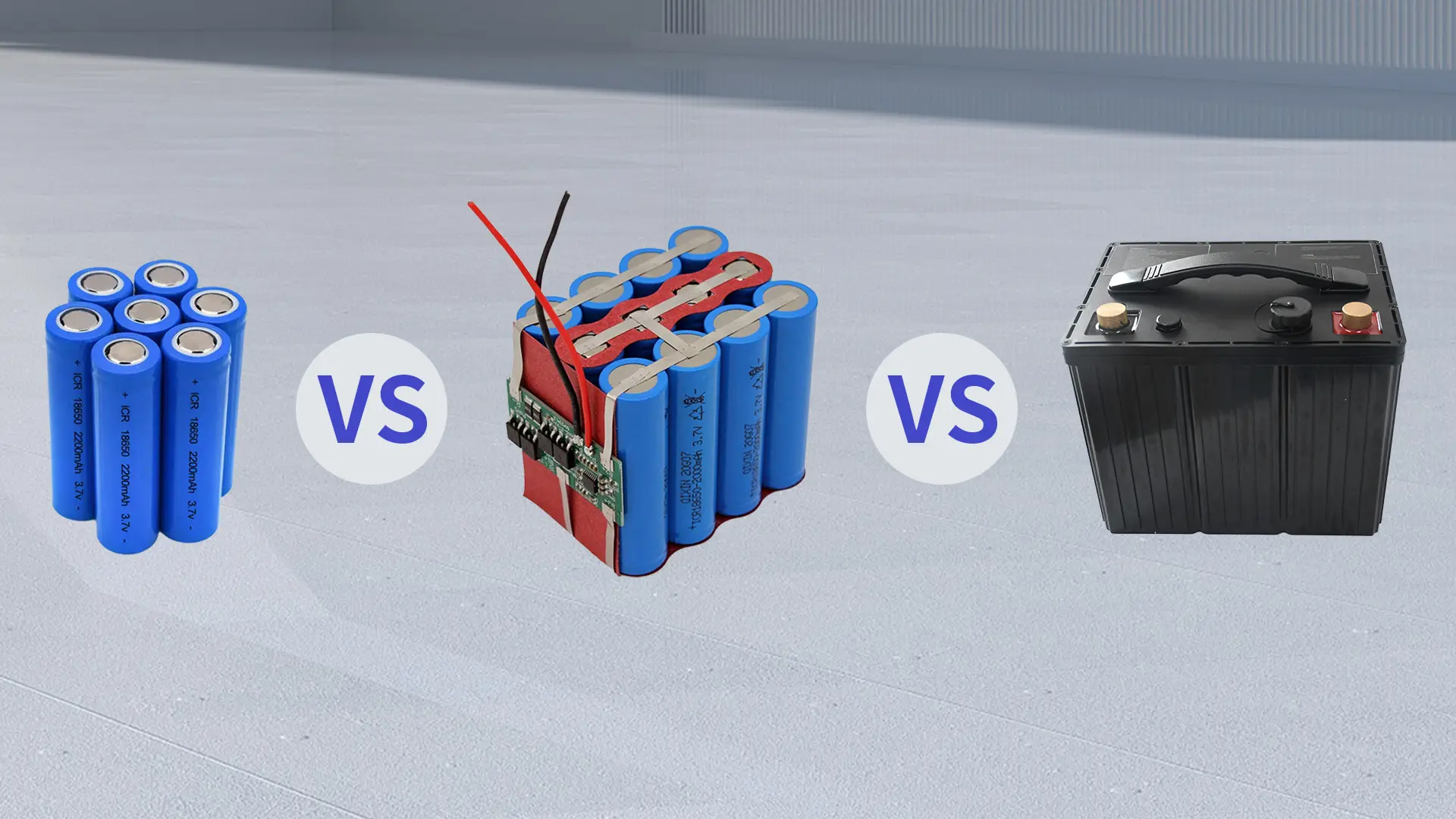
Series/parallel configuration. A 2S5P 26650 battery pack layout (two cells in series for voltage, five in parallel for capacity) is common for 6–7V nominal battery packs; higher-voltage designs stack more cells in series. The right configuration balances target voltage, target capacity, and physical footprint.
Protection circuitry. At minimum, an custom 26650 battery pack needs over-charge, over-discharge, and short-circuit protection built into the BMS. Battery packs with externally exposed wiring — outdoor or field-serviced equipment, for example — also benefit from ESD protection at the pack level, so the pack is safe to install and service without additional external circuitry.
Low-temperature charge derating. This is easy to miss: charge current has to be reduced as temperature drops, typically to around 0.5C at or below 0°C and roughly 0.2C at or below -20°C, to avoid lithium plating on the anode. A BMS that doesn’t account for this will shorten cycle life in cold climates even if the cell itself is rated for low-temperature discharge.
Certification precision. State certifications exactly as held: UN 38.3 for lithium battery transport, IEC 62133 or IEC 62619 for cell/pack safety, and CE or UL/BIS as applicable to the destination market.
Storage and transport conditions. Capacity fade can start before a pack ever reaches the field. Across the datasheets we reviewed, cells stored at roughly 50% state of charge typically retain over 90% of capacity after up to 12 months when kept within -20°C to +25°C, with the allowable storage window widening slightly for shorter periods (up to around 35–45°C for storage under three months). Specifying these conditions in your purchase agreement is a small step that prevents unexpected capacity loss by the time a shipment reaches a customer’s warehouse.
Case Study: A -40°C 26650 Battery Pack for Certified Export
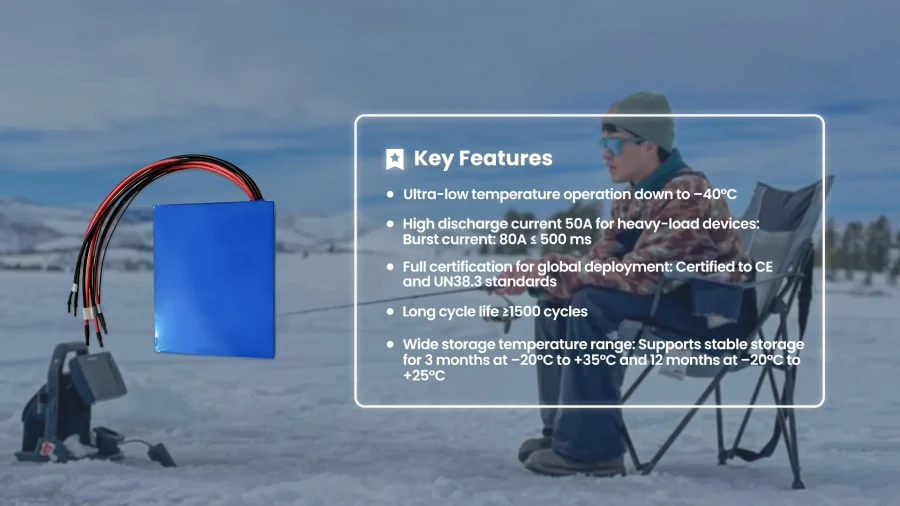
For a customer building outdoor electronics and extreme-environment equipment, CM Batteries developed a fully customized low-temperature LiFePO4 pack rated for reliable discharge at -40°C, with a 50A continuous discharge current (80A burst, ≤500 ms) for peak-load devices.
The battery pack is certified to both CE and UN 38.3 for safe export and worldwide transport compliance, rated for 1,500+ cycles at over 70% capacity retention, and supports stable storage for 3 months at -20°C to +35°C or 12 months at -20°C to +25°C. The finished -40°C 12.8V 9.6Ah low-temperature battery pack shows what’s achievable when cell selection, pack architecture, and certification are engineered together rather than bolted on afterward.
How to Select and Source a Custom 26650 Battery Pack
If you’re evaluating 26650-based pack options for a new product, the sourcing decision comes down to a handful of specifications, not brand reputation alone:
- Target voltage and capacity — determines your series/parallel configuration
- Peak and continuous discharge current — determines whether you need an energy-optimized or power-optimized cell
- Operating temperature range — standard or low-temperature-rated chemistry
- Required certifications for your target market — UN 38.3, CE, UL, BIS, etc.
- Physical footprint constraints — especially if you’re retrofitting an existing housing
An engineering team that validates these against your actual use case — rather than sizing a pack purely against a cell datasheet — is what prevents the kind of field failure described in the case study above. If you’re specifying a custom 26650 battery pack for an industrial or outdoor application, our team can help you work through these trade-offs before you commit to a cell.
Frequently Asked Questions
What Is the Difference Between a 26650 and a 21700 Battery?
A 26650 cell has a larger diameter (about 26 mm vs. 21 mm) and a shorter height (about 65–66 mm vs. 70 mm) than a 21700 cell. 26650 LiFePO4 battery cells are more common in industrial and outdoor pack designs, while 21700 cells — largely NMC chemistry — are more widely used in power tools and EV-adjacent applications due to broader supply availability.
Can You Charge a 26650 Battery in an 18650 Charger?
You can charge a 26650 battery in an 18650 charger only if the charger has adjustable slots that physically accommodate the 26mm-diameter 26650 cell and its charging cutoff voltage matches the battery’s chemistry — 4.2V for NMC 26650s works fine, but standard 4.2V 18650 chargers must never be used for 3.2V LiFePO4 (IFR26650) cells, which require a 3.6V charging cutoff.
Can 26650 Battery Packs Be Customized for Low-Temperature Environments?
Yes. Low-temperature-rated 26650 LiFePO4 battery cells and battery packs can be engineered for reliable discharge down to -40°C, with charge current derated at low temperatures to protect cycle life — see the case studies above for real examples.
What Certifications Should a 26650 Battery Pack Have for Export?
At minimum, UN 38.3 for lithium battery transport is required for international shipping. Depending on the destination market, CE, UL, IEC 62133/62619, or BIS certification may also apply — always confirm which certifications are held versus merely supported per project.