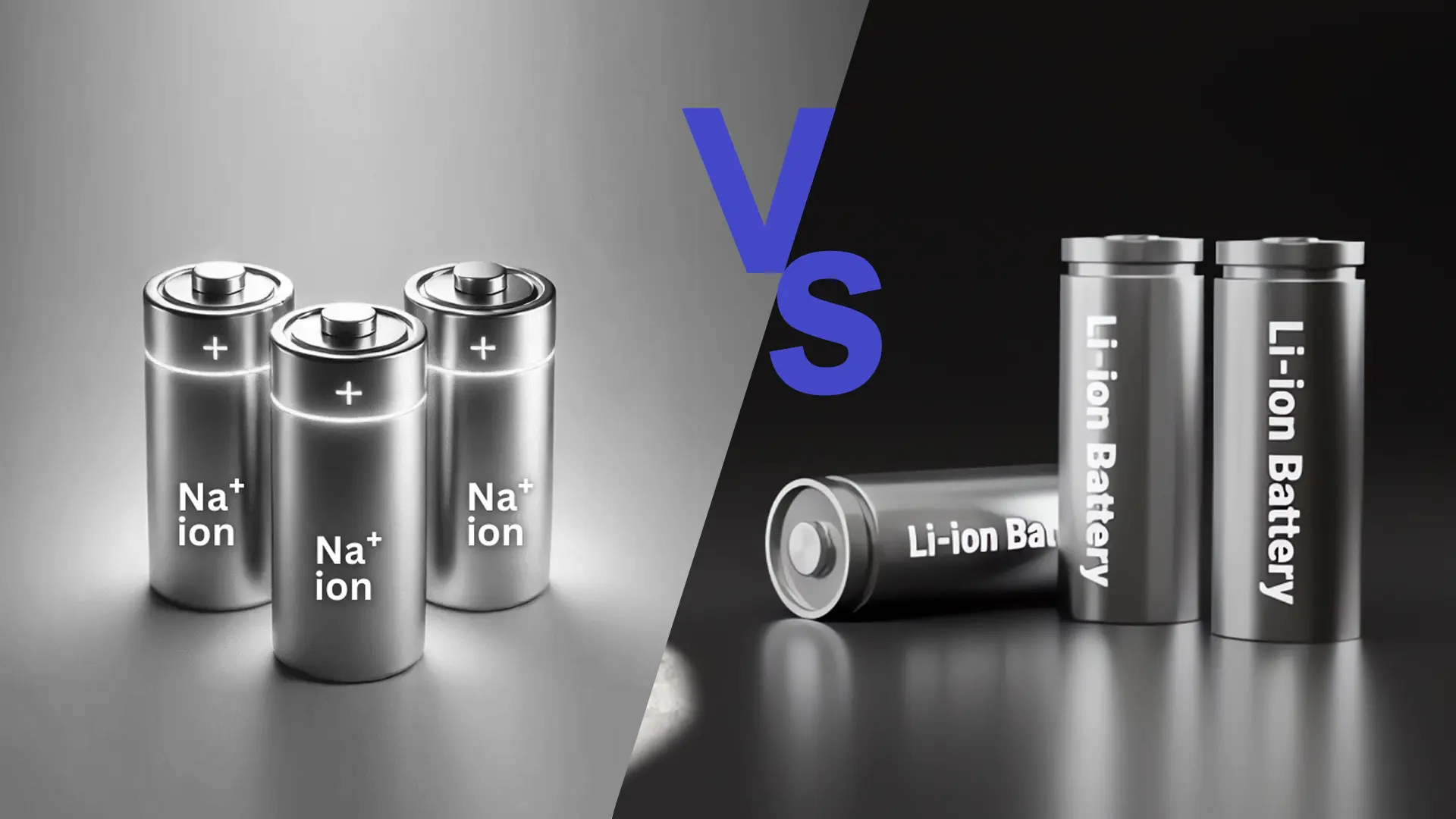
Anode and cathode are two critical components in a lithium-ion battery. The cathode is the electrode where reduction reactions occur, gaining electrons. Conversely, the anode is where oxidation reactions take place, losing electrons. They work together to enable the seamless flow of electric current, powering devices from compact IoT sensors to large-scale industrial systems. This article dives into the definitions, differences, and materials of anode vs cathode.
What are Anodes and Cathodes in Electrochemistry?
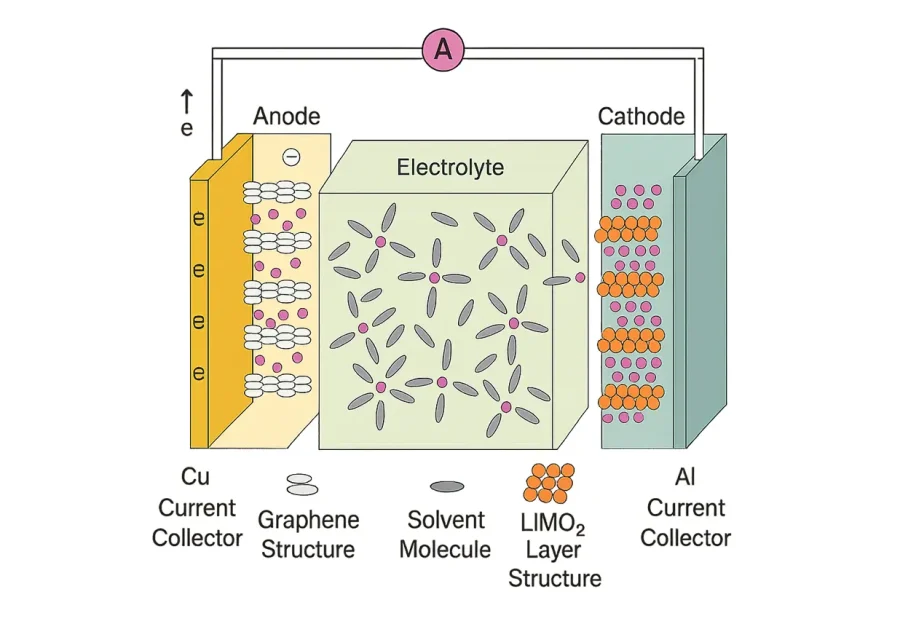
The cathode and anode are two essential electrodes in controlling electron flows and the battery’s electrochemical reaction. It generates voltage, affects the battery’s durability, and achieves energy conversion. Electrons move from the cathode to the anode during charging, storing much energy to power devices.
| Features | Anode | Cathode |
| Reaction Type | Reduction(gain electrons) | Oxidation (lose electrons) |
| Lithium-ion Battery Polarity | Positive Charge (+) | Negative Charge (-) |
| Polarity(Electrolytic Cell) | Negative charge (-) | Positive Charge (+) |
| Materials | NMC, NCA, LiFePO4 | Graphite, Silicon |
What is an Anode?
The anode is the negative electrode that loses electrons nd undergoes an oxidation reaction. During charging, it stores lithium ions transferred from the positive electrode. During discharging, it releases lithium ions while accepting electrons, thereby maintaining the battery’s current circuit.
What is a Cathode?
The cathode is the positive electrode that obtains electrons and undergoes a reduction reaction. It provides a storage location for lithium ions. During discharge, it accepts lithium ions transferred from the anode through the electrolyte. At the same time, the cathode releases electrons to generate an electric current.
Why are Battery Anode and Cathode Confused with Positive and Negative Electrodes?
Uneven electrode coating. This leads to inconsistent local current density within the battery. It is inaccurate to use anode and cathode to describe a battery’s negative and positive electrodes during charging and discharging based on the research. For rechargeable batteries, the positive electrode is the cathode and the negative electrode is the anode during discharging; Their role is reversed during charging. Therefore, the International Union of Pure and Applied Chemistry (IUPAC) recommends the terms positive and negative electrodes when discussing a battery.
How to Determine Anode and Cathode?
From prior knowledge, the anode undergoes oxidation and loses electrons, while the cathode undergoes reduction and gains electrons. In addition, battery marking and a multimeter are two simple ways to help you tell the battery cathode and anode.
- Check Battery Markings. Most battery casings have a plus(+) sign and a minus(-) sign referring to the cathode and anode. Plus signs show cathode, while minus(-) sign indicates anode.
- Multimeter Measurement. Use A voltmeter to measure the battery’s voltage. Connect the red test lead to the cathode and the black test lead to the negative electrode. The connection is correct if the meter shows a positive voltage.
What are the Materials Used for the Anode vs. the Cathode?
Anode active material is graphite-based and silicon-based. Graphite has a layered structure, so lithium ions can intercalate and achieve reversible storage during charging and discharging. It boasts low cost, high energy efficiency, and sound chemical stability. Silicon-based anode materials form alloys with lithium ions, offering higher theoretical specific capacity while exhibiting weak structural stability due to volume expansion.
Cathode active material is transition Metal Oxides, including NMC, NCA, and LiFePO4. These materials have layered and spinel crystal structures that can host lithium ion insertion and extraction. NMC and NMC materials deliver higher energy but poor thermal stability. In contrast, LiFePO4 features superior safety and long cycle life.
How Do Anode and Cathode Work?
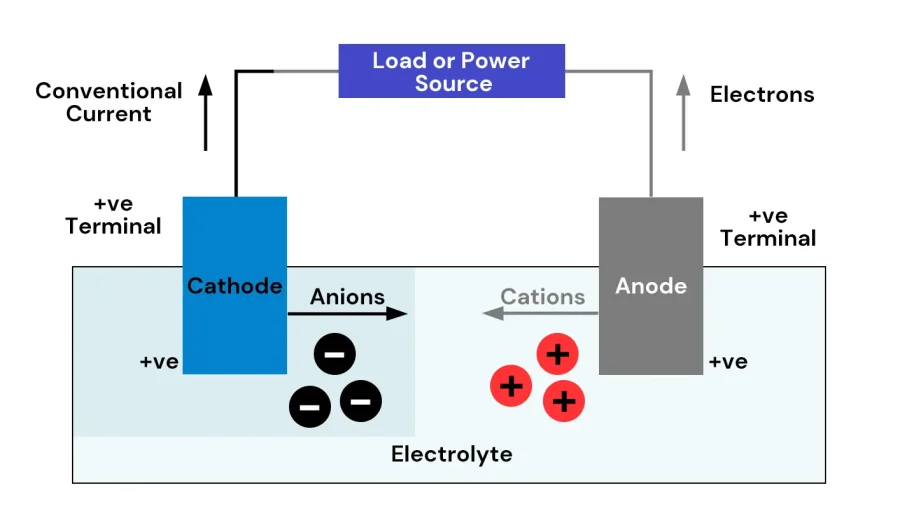
The battery anode undergoes an oxidation reaction, and the cathode undergoes a reduction reaction in both galvanic cells and electrolytic cells. Mastering the galvanic and electrolytic cell working principle helps you get a clear perspective of the working principles of an anode and a cathode.
For a galvanic cell, such as a lithium-ion cell, a redox reaction occurs spontaneously and generates electricity.
In an electrolytic cell, a redox reaction occurs non-spontaneously, requiring energy from the external battery. Its anode serves as the positive electrode because the external battery’s positive terminal supplies energy. Thus, the anode undergoes oxidation, regardless of polarity. External energy simply forces this non-spontaneous oxidation to occur.
| Features | Galvanic Cells | Electrolytic Cells |
| Reaction type | Requires energy to react | Require energy to react |
| Energy Conversion | Chemical energy→Electrical energy | Electrical energy→Chemical energy |
| Anode | Negative electrode | Positive electrode |
| Cathode | Positive electrode | Spontaneous redox reaction |
| Anode reaction | Oxidation | Oxidation |
| Cathode reaction | Reduction | Reduction |
How are Anode and Cathode Materials Manufactured?
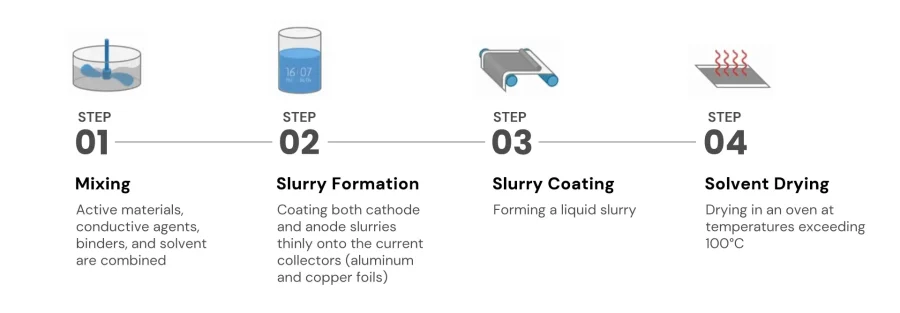
Battery cathode and anode manufacturing contains four steps.
- Firstly, make a slurry by mixing functional materials with binders and conductive components. Adding binders enhances the adhesion between the active material particles. Incorporating conductive additives facilitates electron transport.
- Secondly, a liquid slurry form.
- Thirdly, apply an evenly uniform slurry onto the aluminum foil and copper foil. The anode is made of copper, while the cathode is made of aluminum.
- Then, perform drying and rolling. Dry the coated electrodes in an oven at 100°C. Press the electrodes from both sides with two large rollers, evenly flattening the electrode surface and improving adhesion to the active material. Therefore, Lithium ions can pass through this sound active material.
Finally, the active material spreads thinly and increases density to achieve the great thickness and porosity, thereby improving battery life and performance.
Conclusion
In a nutshell, understanding detailed information about the cathode and anode leverages the huge power potential of your battery-powered devices, such as Ebikes, marine boats, and medical devices.
CM Batteries is dedicated to manufacturing custom lithium-ion batteries with expertise and experience. We utilize high-quality cathode and anode materials in battery cells and provide advanced battery technology support for your applications. If you have any requests, please contact us.
FAQs about the Anode VS Cathode
Is the Cathode Negative or Positive?
It depends on the type of electrochemical device. For a galvanic cell, the cathode is the battery’s positive electrode, where the reduction reaction consumes electrons. Electrons flow into it, causing a higher electric potential, converting chemical energy into electrical energy.
For an electrolytic cell, the cathode is equivalent to the battery’s negative electrode, where an external power source injects electrons, forcing a reduction reaction.
In physics class, I learned electrons flow from cathode to anode, but in chemistry class, my teacher said electrons flow from anode to cathode. Isn’t that contradictory?
Not really. The key is that you are mixing up the concepts of “positive/negative” and “anode/cathode”:
- In physics/electrical circuits, negative terminal is often called the cathode, and positive terminal is the anode, so electrons flow from negative (cathode) to positive (anode).
- In galvanic cells, the anode undergoes oxidation, and the cathode undergoes reduction, so electrons flow from anode to cathode. In a galvanic cell, the anode may be negative (where electrons leave) and the cathode positive (where electrons enter), but the anode/cathode definition is always based on the chemical reaction.
Do electrons always flow from cathode to anode?
The electron flow direction depends on the type of cell:
- Galvanic cell (spontaneous reaction): electrons flow from anode to cathode
- Electrolytic cell (forced by external power): electrons flow from external negative terminal to anode, which may be opposite to a galvanic cell
In short, electron flow is determined by chemical reactions and electrode definitions, not simply “cathode → anode.”
What is the relationship between positive/negative terminals and anode/cathode?
- Galvanic cell:
- Anode = negative terminal
- Cathode = positive terminal
- Electrolytic cell:
- Anode = positive terminal
- Cathode = negative terminal
Key point: positive/negative is about electric potential; anode/cathode is about the chemical reaction. They do not always match one-to-one.