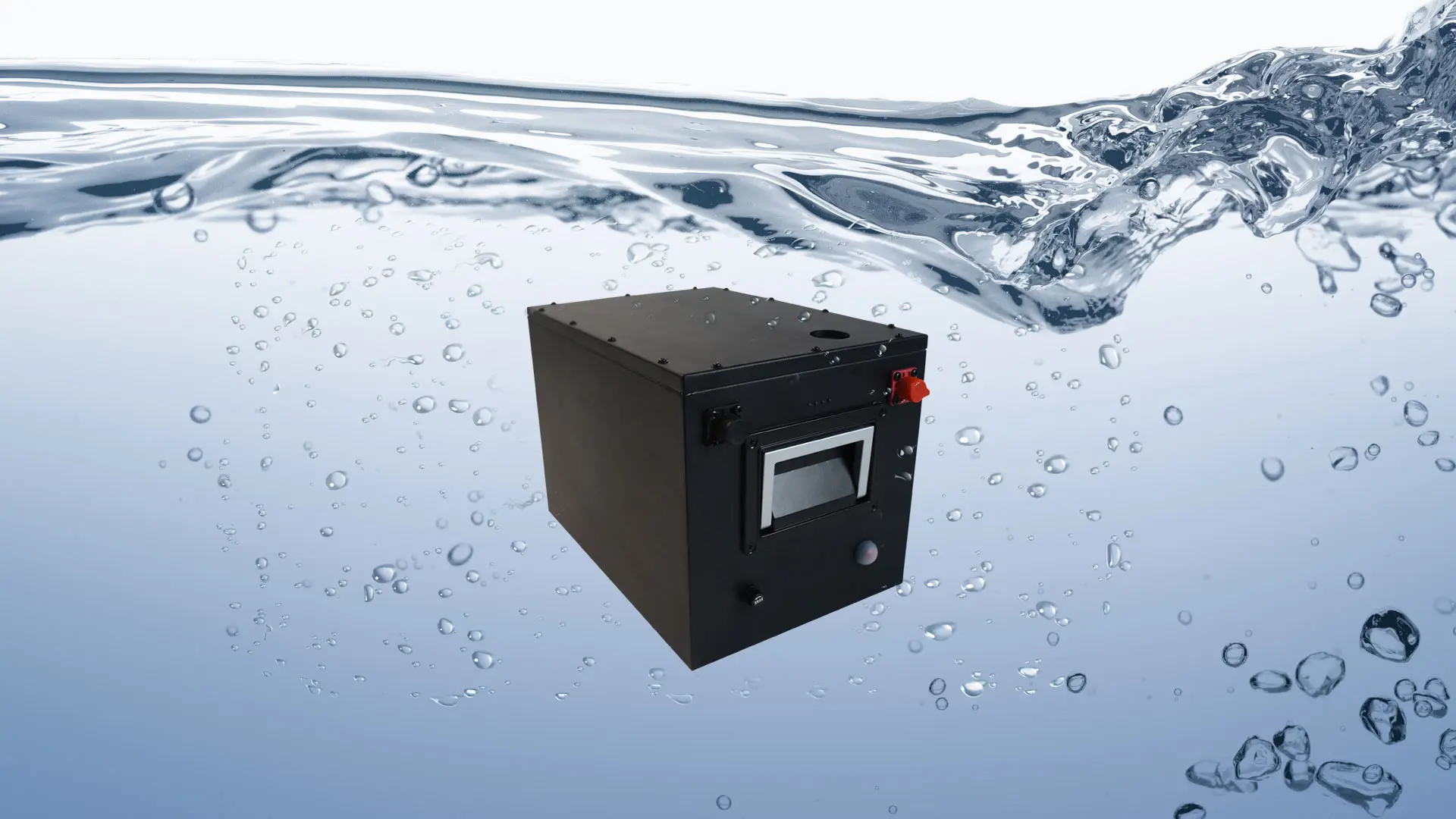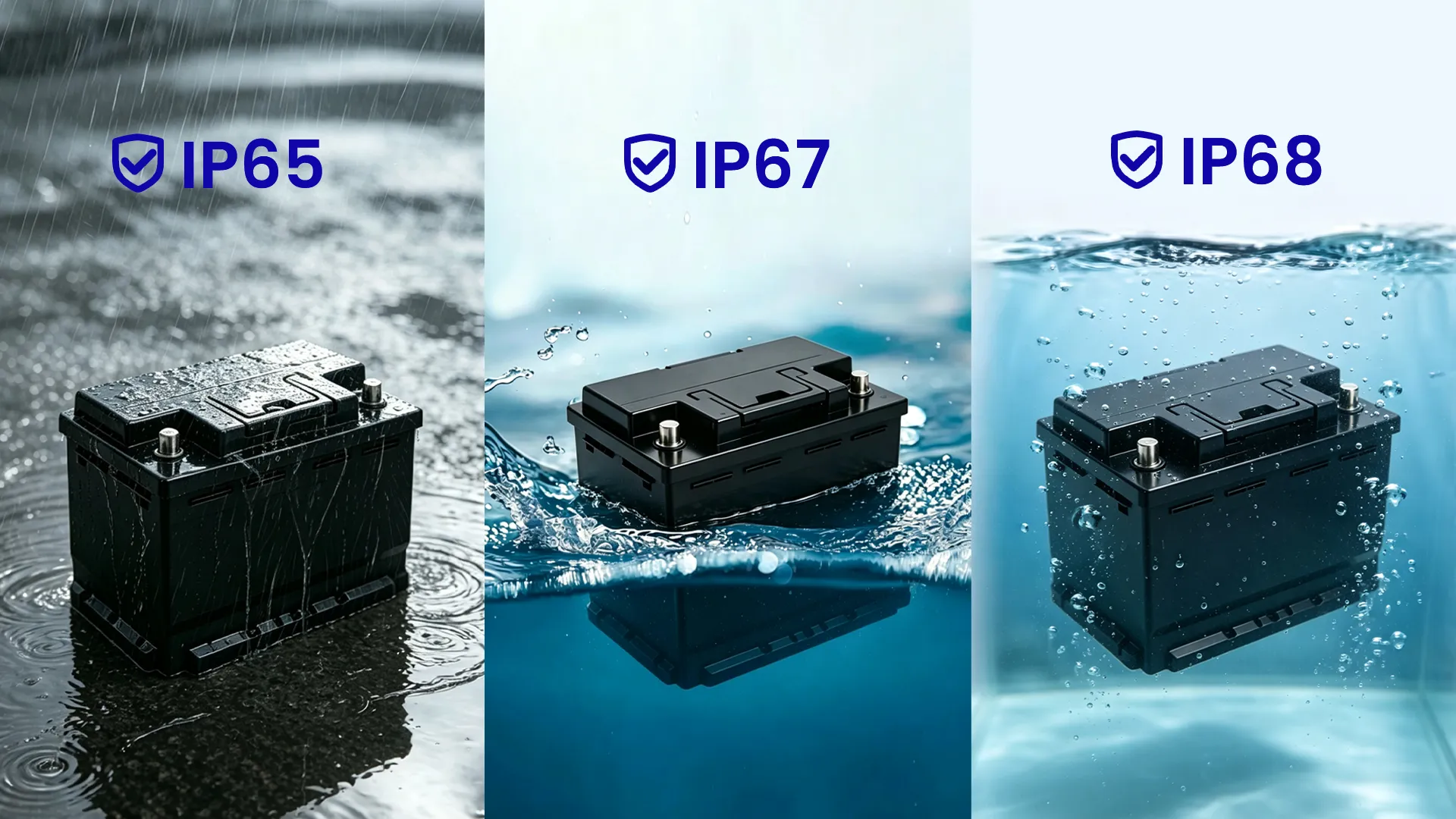
An IP68 rating battery tells you a battery pack passed a test on a specific day, in a specific lab, under specific conditions defined by IEC 60529 — the international standard behind every IP number you’ll see quoted. It does not tell you whether that same battery pack will still be sealed after two years of thermal cycling, UV exposure, and vibration in the field. That gap — between a rating and real-world reliability — is closed by two battery enclosure design decisions most buyers never ask about: sealing architecture and enclosure material.
Quick Answer
For a custom battery pack ,there are three layers that can make up a reliable waterproof battery enclosure: a compression gasket at the seams, a potting or encapsulation compound around the electronics inside, and a pressure-equalization vent membrane where thermal cycling happens. Each layer is designed to work with the environment it will be exposed to.
The choice of material is also based on exposure: anodized aluminum is best for most industrial and farming uses, 316 stainless steel is best for long-term immersion in saltwater, and engineering plastics are best for low-cost, low-thermal-load uses. Getting the IP rating right on a test bench is only the first step. The design of the enclosure is what determines whether that rating still holds up after two years of use in the field.
For a full breakdown of how IP65/67/68 ratings are defined and tested, see our comprehensive guide to IP ratings. This guide picks up where that one leaves off — at the point where an engineer has to actually specify a gasket, a potting compound, a vent, and an enclosure material.
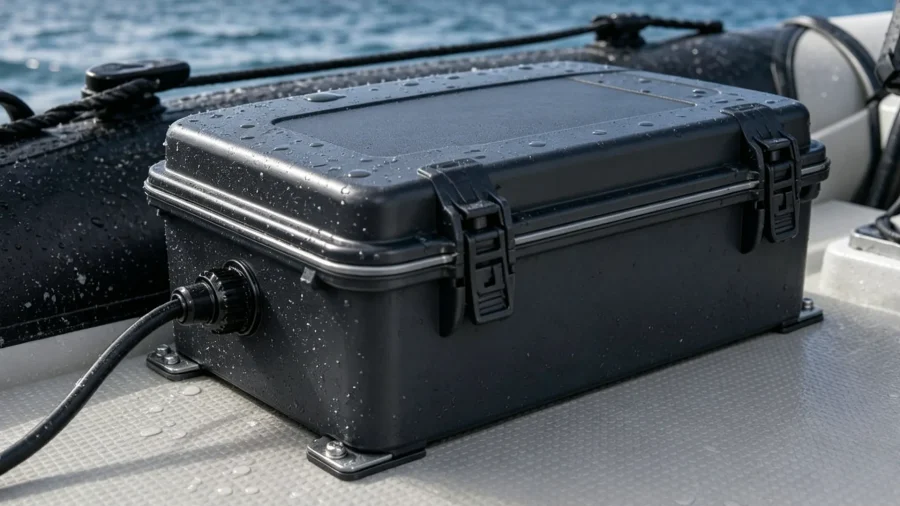
Sealing Architecture: Gasket, Potting, and Vent Design
A waterproof battery enclosure typically relies on three sealing mechanisms working together, not one. Treating them as interchangeable is one of the most common design mistakes we see.
Gasket and O-Ring Sealing
A compression gasket seals by deforming under clamping force to fill the microscopic gaps between two mating surfaces, then using its own rebound force to keep pushing back against that surface. Sealing holds as long as rebound force and friction exceed the pressure trying to force water through. It fails when the gasket takes a permanent “compression set” — it stops springing back — or when the mating surfaces aren’t flat enough for the gasket to fill the gap.
Three material families dominate:
- Silicone foam gaskets — wide temperature range, excellent long-term elasticity, low compression set even after years of thermal cycling. The default choice for enclosures that get opened and re-sealed for maintenance.
- Solid rubber gaskets (EPDM, NBR) — higher sealing force at a given compression, lower cost, but a narrower température range and faster degradation under UV and ozone exposure if used on exterior-facing seams.
- Foam tape / adhesive gaskets — fastest to apply in production, but generally offer lower long-term sealing performance and shorter service life than a mechanically compressed gasket, making them better suited to secondary sealing than a primary structural seam.The design detail most often missed: the gasket groove width must be sized to the specific compression ratio of the chosen material (usually 15–30% for silicone foam), not to whatever groove fits the housing geometry. Under-compress and there’s no seal; over-compress and the gasket takes a permanent set within months.
Potting and Encapsulation Compounds
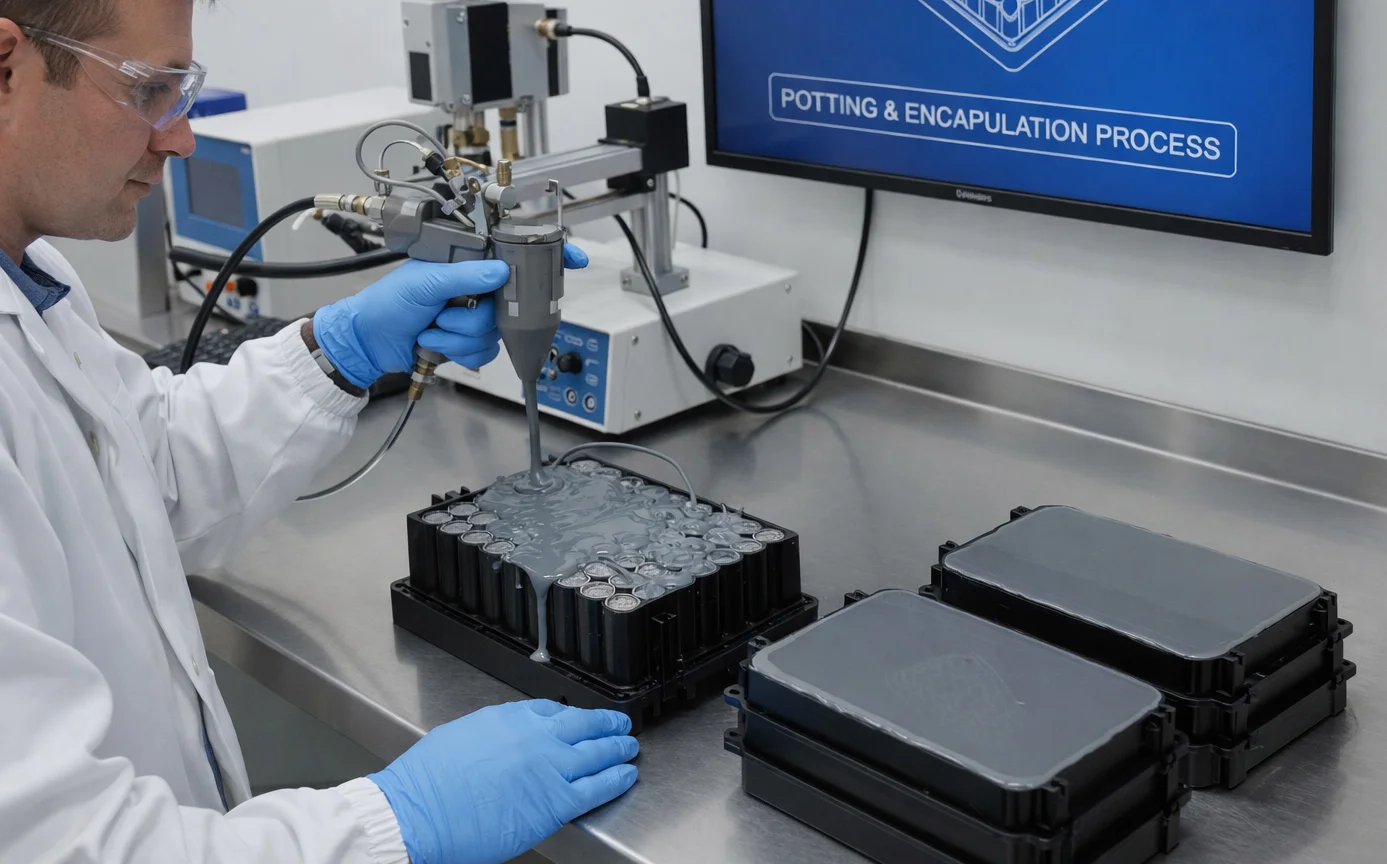
Potting seals a volume rather than a seam — it fills the space around cells, BMS, and internal wiring so there’s no air gap left for moisture to condense in.
Sodium-Ion vs LiFePO4 Chemistry: What Actually Changes?
Sodium-ion and LiFePO4 batteries work on the same basic principle — ions shuttle between a cathode and an anode during charge and discharge. What changes is the ion itself, and that single substitution ripples through the entire cell design. (For a broader side-by-side of sodium-ion against lithium-ion chemistries in general, see our detailed comparison guide; here we’re narrowing in specifically on the LiFePO4 comparison.)
| Compound | Where it wins | Where it costs you |
| Epoxy | Highest rigidity, best moisture barrier, strong electrical insulation | Slow cure, generates heat while curing, essentially impossible to rework once cured |
| Polyurethane | Flexible, tolerates vibration and thermal expansion without cracking | Can absorb moisture over time if not properly formulated; narrower service temperature range than epoxy |
| Silicone | Best thermal conductivity of the three, stays flexible across a wide temperature range | Higher material cost; some formulations off-gas compounds that can affect nearby components during cure |
The trade-off that matters most in practice is thermal: full potting improves mechanical and moisture protection but reduces the enclosure’s ability to dissipate heat, because it removes the air gaps that would otherwise let convection carry heat away.
For high-discharge-rate battery packs, partial potting (encapsulating the BMS and connection points, leaving cell surfaces exposed to a thermal pathway) is often the better trade-off than full encapsulation.
Pressure-Equalization Vent Membranes
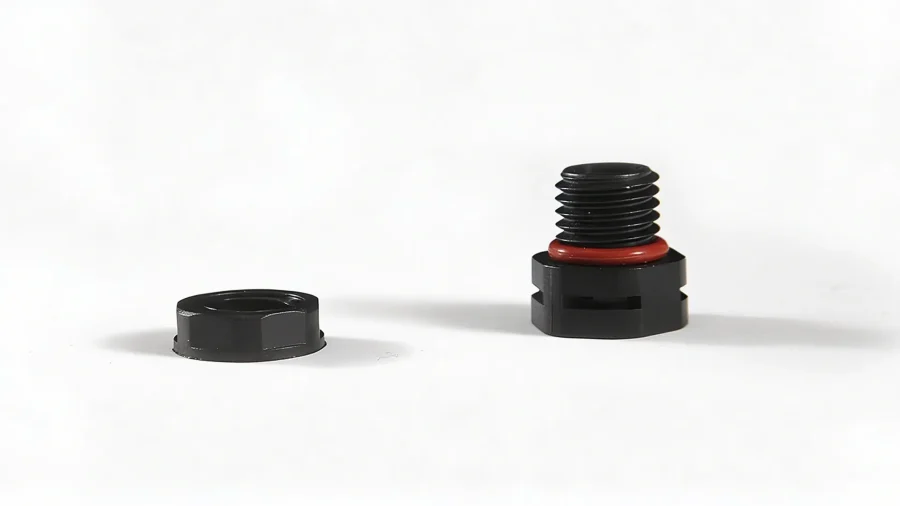
Most waterproof battery articles skip this entirely, yet it’s arguably what separates a pack that survives one submersion cycle from one that survives thousands of thermal cycles without stressing its own seals.
A sealed enclosure heats up during charge/discharge and cools afterward — every cycle, the internal air expands and contracts. Without a way to equalize that pressure, the enclosure either has to resist the resulting differential indefinitely, or that differential pulls water past the gasket on the cooling stroke.
A pressure-equalization vent — typically a hydrophobic PTFE or expanded-PTFE membrane — solves this by letting air pass while blocking liquid water, using a pore size small enough to reject water’s surface tension but large enough for air molecules.
Selection criteria that actually matter for the membrane itself:
- Airflow rate matched to the enclosure’s internal volume and expected thermal cycling rate — undersized membranes can’t equalize fast enough during rapid temperature swings.
- Water entry pressure (WEP) rating — how much external pressure the membrane resists before water is forced through; this must exceed the maximum hydrostatic pressure the enclosure sees at its rated depth.
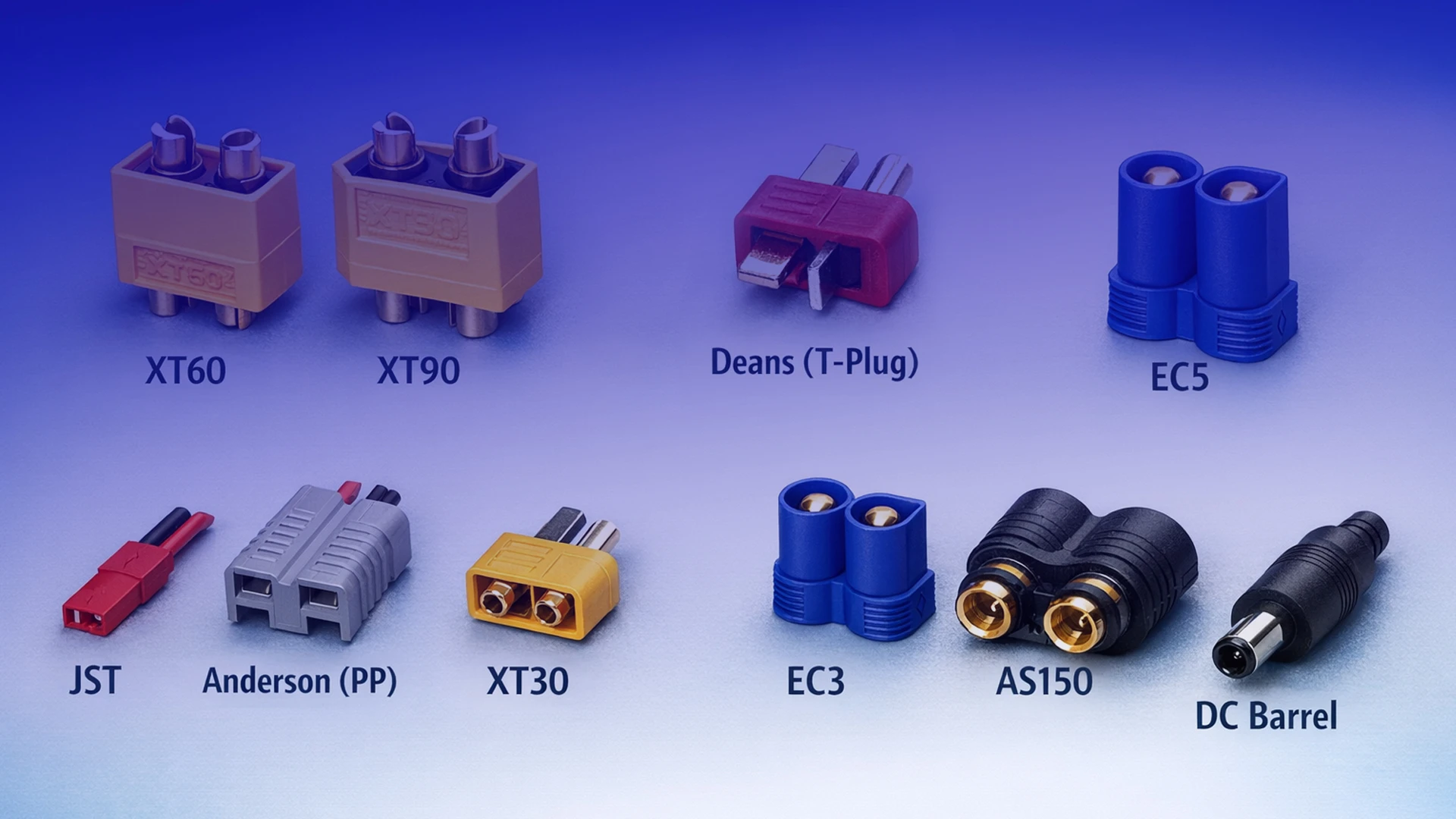
- Placement — away from direct spray or submersion zones, and physically separated from cable/connector penetrations, which are already the most common failure point in an IP68 system (we’ve covered why in our connector and disconnect switch guide).
Matching Sealing Architecture to Application Environment
There’s no single “best” sealing architecture. The right combination depends on whether the enclosure faces continuous immersion, intermittent splash, or mechanical abuse alongside water exposure.
Continuous Subsea Immersion
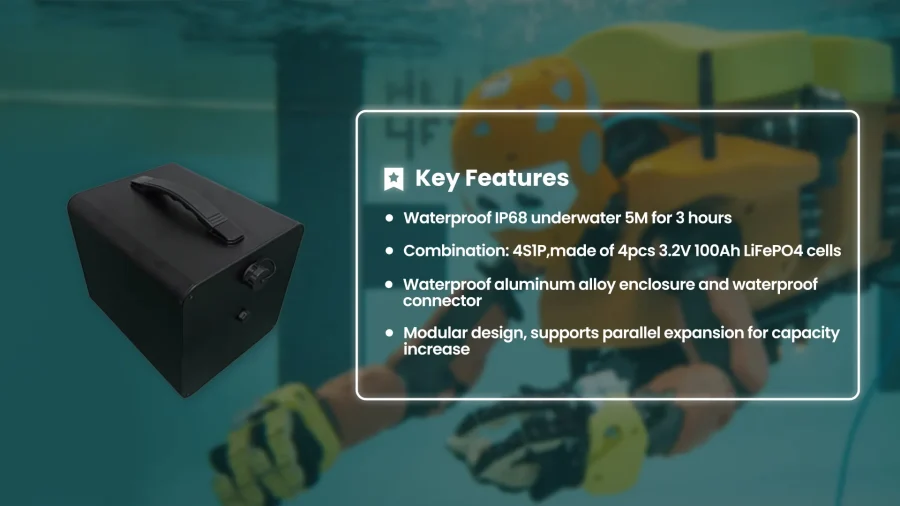
Hydrostatic pressure is constant and depth-dependent, so the priority is a sealing system that doesn’t rely on a vent at all, or uses a pressure-compensated design instead. Full potting plus a high-compression gasket rated for continuous submersion is typically the right call here.
Our 12.8V/105Ah IP68 modular battery pack for subsea robotics is built around this logic.
Outdoor Industrial IoT
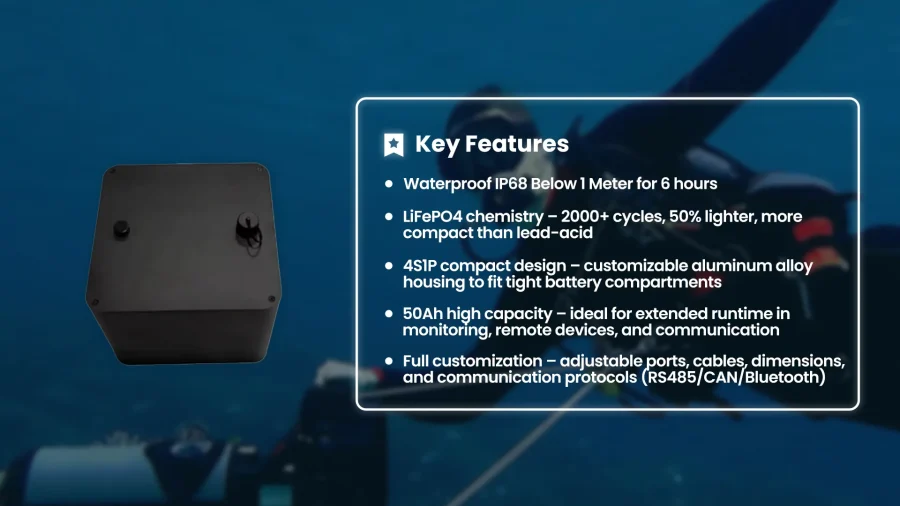
Exposure is intermittent — rain, splash, occasional full immersion — while thermal cycling from sun exposure is significant, so a vent membrane earns its place alongside a silicone gasket and conformal-coated PCB.
This is the architecture behind our 12.8V/50Ah IP68 waterproof battery pack, built as a lead-acid replacement for outdoor equipment.
Agricultural Robotics
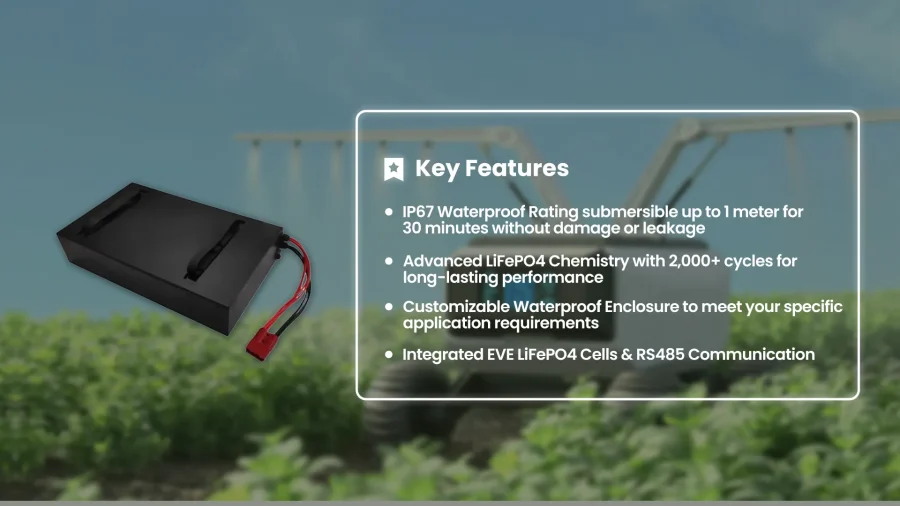
Water exposure usually takes a back seat to vibration, dust, and mud ingress, which changes the calculus: the gasket needs to handle mechanical fatigue from constant vibration more than sustained hydrostatic pressure — part of why this application is typically specified at IP67 rather than IP68.
Our 25.6V/120Ah IP67 waterproof battery pack reflects that environment-driven rating choice rather than defaulting to the highest number available.
Enclosure Material Selection: Aluminum Alloy vs Stainless Steel vs Engineering Plastics
Material choice interacts directly with everything above: it determines how the gasket groove is machined, how potting adheres, and how much the enclosure itself contributes to — or resists — corrosion at the seal line. Use this three-step approach when specifying a material:
- Identify exposure duration and medium — occasional freshwater splash, continuous freshwater, or continuous saltwater.
- Identify the thermal load — high-discharge-rate packs need a material that helps dissipate heat; low-load packs don’t.
- Weigh weight and cost against the corrosion margin actually required — don’t default to the most corrosion-resistant option if the exposure profile doesn’t justify it.
Aluminum Alloy
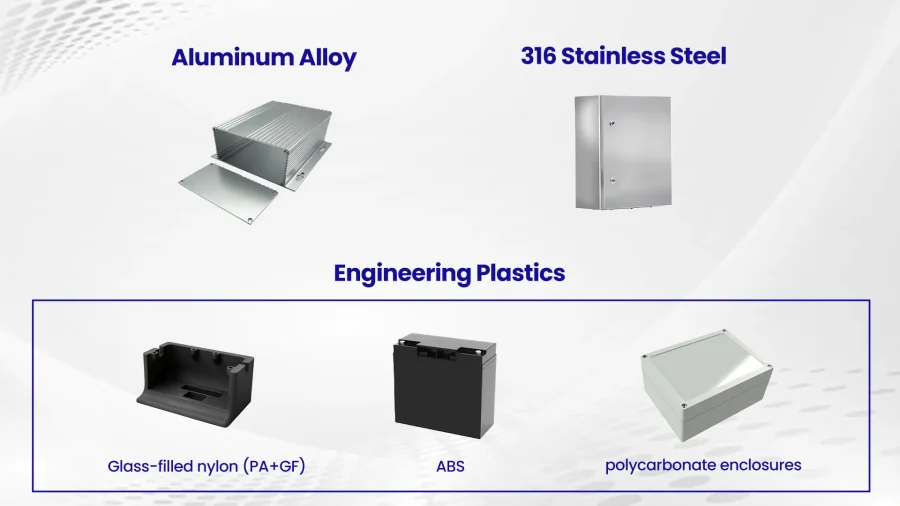
Aluminum (typically 5052 or 6061, anodized) is the default choice for most industrial waterproof enclosures because it combines low weight with genuinely good thermal conductivity — heat generated by the cells and BMS has somewhere to go, which matters more once you’ve potted the internals and removed convective cooling paths.
Anodizing adds a hard oxide layer that resists general corrosion well in freshwater and humid environments, though it’s more vulnerable than stainless steel to pitting in prolonged saltwater exposure unless the anodizing is specified thick enough (typically Type III hard-coat) for that environment.
316 Stainless Steel
316 stainless steel is the material of choice when saltwater exposure is continuous rather than occasional. Its molybdenum content gives it meaningfully better resistance to chloride-induced pitting corrosion than standard aluminum alloys or even 304 stainless — resistance that’s typically benchmarked using the ASTM B117 salt spray test, the industry-standard method for comparing corrosion performance across materials.
That resistance comes at a real cost: 316 stainless is roughly three times the density of aluminum, and typically more expensive both as raw material and to machine. For a continuously submerged subsea enclosure, that trade-off is usually worth it; for an enclosure that only sees occasional splash, it’s often over-engineering.
Engineering Plastics
Glass-filled nylon (PA+GF), ABS, and polycarbonate enclosures skip the corrosion question altogether — they don’t corrode — and their inherent dielectric properties mean the enclosure itself can double as electrical insulation, simplifying internal design.
The trade-offs run the other way: lower mechanical strength than metal for a given wall thickness, poor thermal conductivity (heat has nowhere to go without added internal thermal pathways), and a real risk of UV-driven embrittlement outdoors unless the resin is properly UV-stabilized. These materials typically fit cost-sensitive, low-thermal-load applications better than high-discharge-rate or structurally demanding ones.
| Material | Corrosion resistance | Thermal conductivity | Relative weight | Relative cost | Best fit |
| Aluminum alloy (anodized) | Good in freshwater/humid; needs thick anodizing for saltwater | High | Low | Moderate | Most industrial IoT, agricultural robotics |
| 316 Stainless steel | Excellent, including continuous saltwater | Moderate | High | High | Continuous subsea/marine immersion |
| Engineering plastics (PA+GF, ABS, PC) | Excellent — doesn’t corrode | Poor | Low | Low–moderate | Cost-sensitive, low thermal load applications |
A note on transparency: the qualitative comparisons above reflect established materials-engineering properties.
Material and Seal Interaction: Where Galvanic Corrosion Really Happens
We’ve written elsewhere about galvanic corrosion at the connector’s electrical contacts — the point where dissimilar metals in a mated connector pair can corrode when moisture bridges them (see our battery connector types guide for that mechanism). But there’s a second, easily overlooked location where the same electrochemistry causes problems: the interface between the enclosure material itself and its fasteners or connector housing.
When two dissimilar metals are in direct contact and an electrolyte (saltwater, or even persistent condensation) bridges them, the more anodic metal corrodes preferentially — this is basic galvanic series behavior, not a CMB-specific finding.
In practice, that means an aluminum enclosure fastened with uncoated stainless steel screws, or mated to a stainless steel connector housing without isolation, will show accelerated corrosion at the aluminum around every fastener point long before the rest of the enclosure shows wear. This is often mistaken for a gasket failure when the actual root cause is metal incompatibility at the fastening points.
Mitigation is straightforward once the mechanism is understood: isolating washers or bushings between dissimilar metals, compatible fastener selection (aluminum enclosures paired with aluminum or coated fasteners rather than bare stainless), or a dielectric coating at the contact point.
How CMB Validates Sealing and Material Durability
Design principles only matter if they’re verified before a pack ships. Sealing and material choices at CMB go through the same test-and-disclose methodology described in our reliability test framework, including submersion testing at rated depth and duration. Shock and vibration testing is validated against protocols appropriate to the target application — the kind of benchmarks referenced in standards such as MIL-STD-810 for equipment exposed to field vibration and mechanical shock.
Waterproof Battery Enclosure Design FAQ
What’s the Difference Between a Gasket and Potting in a Waterproof Battery Enclosure?
A gasket seals a seam — the joint between two enclosure halves, or around a connector penetration. Potting seals a volume — it fills the internal space around cells and electronics so there’s no air gap for moisture to condense in. Most reliable designs use both, not one instead of the other.
What Is a Potting Compound in a Battery Enclosure?
A potting compound is a liquid resin — typically epoxy, polyurethane, or silicone — poured or injected around a battery’s internal cells, BMS, and wiring, then cured solid. It eliminates internal air gaps, protects against moisture and vibration, and can improve heat dissipation depending on the compound’s thermal conductivity.
How Do I Choose the Right Enclosure Material for a Waterproof Battery Pack?
Start from the exposure profile, not the highest-spec material available. Continuous saltwater immersion favors 316 stainless steel despite the weight and cost penalty. Intermittent splash with thermal cycling usually favors anodized aluminum for its thermal conductivity. Cost-sensitive applications with low thermal loads and no continuous saltwater exposure can often use engineering plastics.
Is 316 Stainless Steel Better Than Aluminum for a Waterproof Battery Enclosure?
Not universally — it depends on the exposure. 316 stainless steel resists chloride-induced pitting corrosion better than aluminum, making it the stronger choice for continuous saltwater immersion. But it’s roughly three times heavier and generally more expensive to source and machine. For freshwater, humid, or intermittent-splash environments, anodized aluminum’s thermal conductivity and lower weight typically make it the more practical choice.
Why Does a Sealed Enclosure Need a Vent Membrane at All?
Because a fully sealed enclosure still has to deal with internal air expanding and contracting through every charge/discharge thermal cycle. Without a pressure-equalization membrane, that pressure differential either stresses the enclosure structurally or pulls moisture past the gasket as the enclosure cools — a hydrophobic membrane lets the air pressure equalize without letting water through.
What Happens if the Seal Fails Despite a Good IP Rating?
An IP rating describes a pass/fail test result, not a guarantee against every failure mode over years of service. If a seal does fail and water reaches the cells, the consequences can escalate quickly — we’ve covered that failure chain in detail in what happens if a lithium-ion battery is submerged in water.
Getting sealing architecture and material selection right from the start is far cheaper than retrofitting a design after field failures. If you’re specifying a custom battery enclosures or waterproof battery pack for subsea, outdoor industrial, or agricultural robotics applications, our engineering team can walk through the trade-offs for your specific environment — start with our waterproof battery pack overview or reach out directly for a technical consultation.